

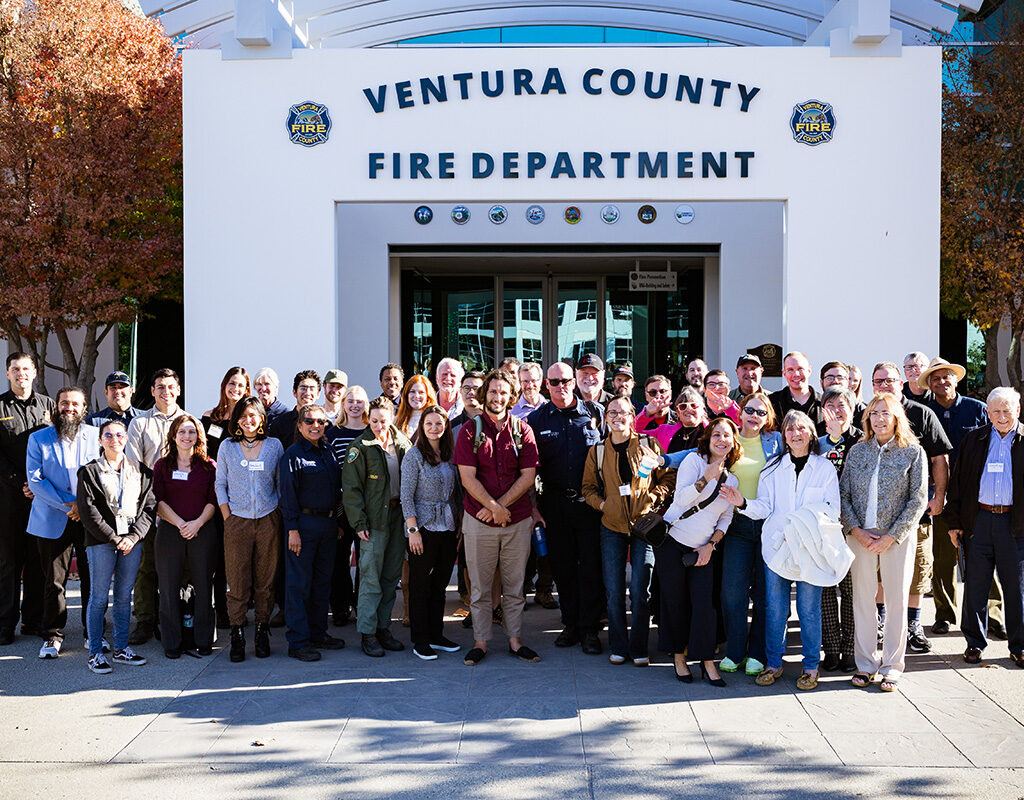
As wildfires continue to reshape life across California, CSUN’s Institute for Sustainability has stepped into a critical leadership role — bringing leaders in firefighting and fire-prevention efforts together to build trust and share knowledge. The overall goal: to strengthen communities and prepare them for what’s become a year-round fire season.
On December 8, 2025, the CSUN Institute for Sustainability, with its partners. convened leaders who work in the field on wildfire resilience from across Southern California at the Ventura County Fire Department in Thousand Oaks for a daylong Wildfire Resilience Summit. CSUN staff and students helped create a collaborative spirit among the participants, who were ready to share the lessons they learned over years of devastating wildfires, including the Eaton and Palisades fires just 11 months before, said Institute Director Sheila Steinberg.
“Wildfire resilience is a very important topic, because it impacts all of us here in Southern California.” Steinberg said. “Wildfire resilience isn’t just about response, it’s mostly about communication and building community. Local engagement, with people to share their stories about people and place, is something we’re very good at. [The summit] brought people together who work on the front lines of wildfire resilience to share their expertise, knowledge and what works and doesn’t work.”
“We had people attend from across the geographies including Orange County Fire, L.A. County Fire, Ventura County Fire and we had all these nonprofits,” she said. “CSUN’s role as a convener created space for authentic conversations and dialogue about problem solving.”
Steinberg noted the event involved major support from institute staff and others at CSUN including the College of Social and Behavioral Sciences led by Dean Yan Searcy.
Ventura County Fire Department Director of Communications and Public Affairs Scott Thomsen collaborated with Steinberg on the event. He said there were several objectives, including sharing success stories and ways to reproduce those programs.
“[Another] goal was to identify some of the challenges that are still out there for everyone working in this space and try and identify ideas for how we can make improvements,” he explained. [Plus] networking and relationship building among this group of thought leaders — so that they have the connections necessary to address some of those challenges.”
More than 80 people participated in the summit — including representatives from county and state firefighting agencies, as well as nonprofits that deal with wildfire resistance, mitigation and recovery efforts. Congressman George Whitesides, who represents the Santa Clarita and San Fernando Valleys, was also on hand to welcome attendees and share updates.
The first sessions of the day were “Storytelling Case Studies” — eight specific case studies were shared by nonprofit organizations and agencies. There were also talks on wildfire and disaster preparedness efforts from both government and nonprofit groups such as the Ventura Regional Fire Safe Council.
In the afternoon, a collective of volunteers, including students, Climate Action Fellows from the Institute for Sustainability and members of the non-profit group Conservation Concierges helped facilitate small group discussions.
Sumedha Uppal, a senior majoring in computer information technology in the Andrew J. Anagnost College of Engineering and Computer Science, works as an institute research assistant. She led one of the discussion groups where participants discussed challenges, such as the lengthy processes to obtain permits and permissions to conduct work to reduce wildfire risks. Uppal is leading the research effort to co-author a report from the day’s findings.
“Working on this report has helped me enhance my analysis skills through mentorship with Dr. Steinberg,” Uppal said. “And moderating [the group discussion] was really helpful, helping facilitate and [learning] how to keep people engaged.”
The report will be released in March 2026 and will be shared widely with participants from the event, including distribution to local, regional and state leaders, Steinberg noted. “This event is a jumping off point for future engagement with people who care about wildfire and communities,” she said
Thomsen said he’d like discussions to continue and is exploring creating working groups focused on issues brought up during the summit.
“The academic support of the university, to be able to share these findings in other spaces where it will be taken seriously — and [to] have the … institute turn the results of this event into a report that can be shared in spaces we might not reach otherwise — that combination [is] really powerful,” he said.
Steinberg notes that Institute for Sustainability staff are planning to create topical work groups to continue the conversation and said there will be opportunities for students to get involved. The dates for these various engagement sessions and events will be shared through the institute’s website.
CSUN’s Institute for Sustainability was established in 2008 to raise awareness about sustainability across campus and in local communities. The main focus is on education and outreach and giving students hands-on opportunities to get involved with meaningful research opportunities.



Comments are closed.