

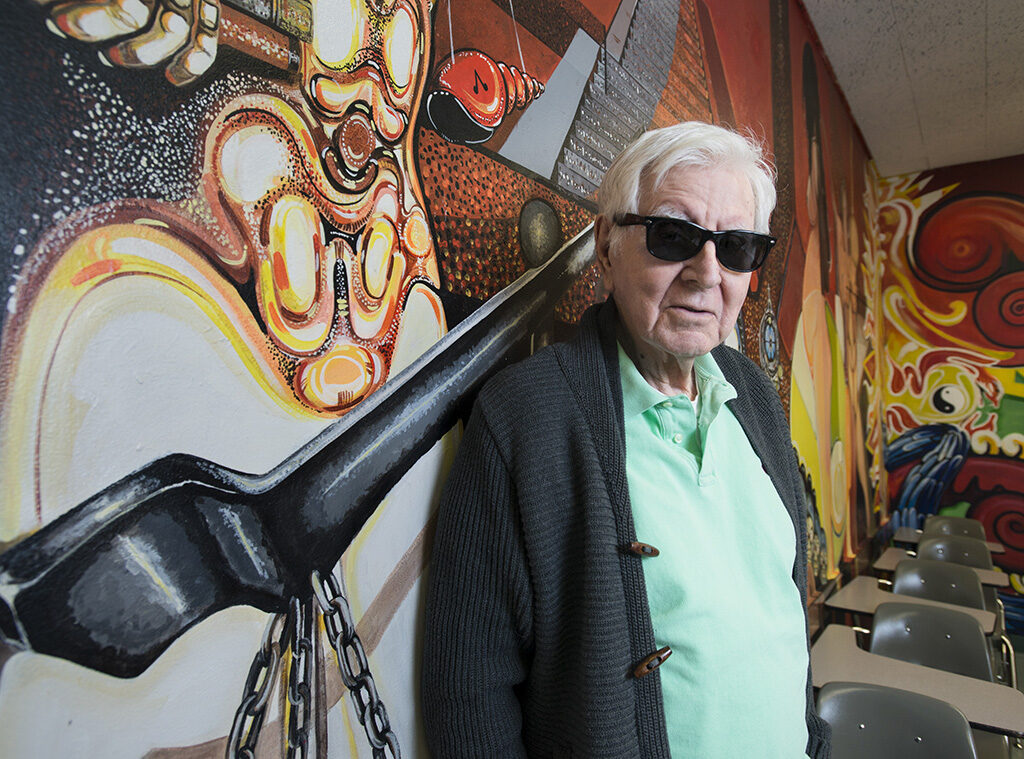
Rodolfo “Rudy” Acuña, who founded the Chicana/o Studies department at what was then San Fernando Valley State College in 1969 and is considered as one of the “academic fathers” of the field, has died. Acuña was 93. CSUN President Erika D. Beck said his work left “an indelible mark” on campus and in ethnic studies programs across the nation.
“His legacy of scholarship, advocacy, and unwavering dedication to social justice will continue to inspire future generations,” she said. “We extend our deepest sympathies to his loved ones and to all who were touched by his life’s work.”
After news of his passing was shared on the CSUN Chicana/o Studies Instagram page, former students and mentees filled the comments with personal tributes — revealing that the scholar who taught for more than four decades at CSUN is remembered as much for his encouragement, mentorship and deep commitment to his students as for his foundational role in academia.
“It was an honor to be your student and to have met you,” said Instagram commenter @_____theycallmetee. “You always said I was very curious and very preguntona [inquisitive], a trait I’ll cherish forever.”
Acuña served as the founding chair of the Mexican American studies department, which became the Chicana/o studies department in the College of Humanities. The program was created at the height of the civil rights movement, when students demanded that more minority faculty be recruited and to establish curriculum that reflected students’ diverse backgrounds. The “Storm at Valley State” documentary chronicles this period in time, when the Chicana/o studies and Africana studies (formerly known as Pan African studies) departments were created, as was the Educational Opportunity Program, designed to support first generation college students or those from educationally or economically disadvantaged backgrounds.
For the brand new department, Acuña developed a curriculum of 45 courses that launched in the fall of 1969.
Gabriela Chavira, director of CSUN’s Office of Undergraduate Research, and professor of psychology, first met Acuña as an undergraduate student, when she took his course, Chicana/o Studies 445, History of the Chicano.
“He encouraged students to use their critical thinking skills and question the source of all information we receive,” she said.
Chavira said he told his students to keep asking questions.
“Is it a primary source? Whose voice is being represented? Whose voices were silenced?” Chavira said. “He really was the first professor to help me ‘unlearn’ what I had learned in K-12, which often reflected the perspectives of white middle-class to upper-class men and excluded females and people of color.”
Chavira said when she joined the student organization, Movimiento Estudiantil Chicano de Aztlán (MEChA). in her sophomore year, Acuña was the co-mentor for the program. He also encouraged her to pursue doctoral studies in developmental psychology.
“When I returned to CSUN as an assistant professor of psychology in 2004, he helped me network across campus — as a colleague,” she noted.
MariaElena Zavala, professor of Biology, said Acuña was one of the first colleagues she met outside her department when she began teaching at CSUN in 1988. She describes him as a “truth-teller,” particularly regarding the Chicana/o experience in the United States.
“He was just honest about his opinions and he didn’t pull punches. And I like that in people,” Zavala said. “His idea was to have you think about it and evaluate it.”
Zavala said her talks with Acuña prompted her to read some of his published writings.
“Rudy could be a disrupter,” she said. “His disruptions could be unsettling to people because, he sometimes used words that were pointed to get people to think.”
Acuña, who was born in Los Angeles, in Boyle Heights, earned his doctorate in Latin American Studies, with a concentration in history, in 1968 at USC. He is the author of more than 20 books, including “Occupied America: A History of Chicanos” which served as a foundational text for Chicano/a studies in higher education across the country.
He also wrote numerous academic articles and book chapters, as well as book reviews and opinion pieces. On his website, “rudyacuna.net” his writings are documented, as are the awards that he received, including the National Hispanic Institute Lifetime Achievement Award (2008) and a Lifetime Achievement Award from the Mexican American Legal Defense and Education Fund (2010).



Comments are closed.