

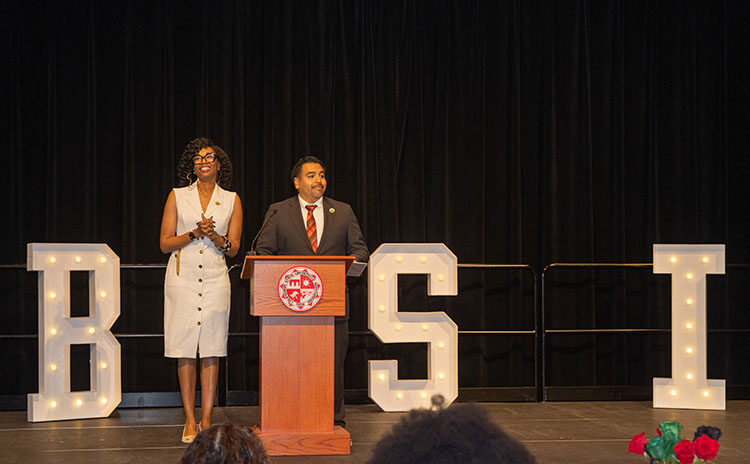
CSUN last month celebrated the official launch of the university’s Black-Serving Institution era, but these goals and strategies have been in the works for years. University leaders are also laser-focused on the road ahead, as CSUN implements strategies for the next five years of Black-Serving Institution (BSI) work — and beyond.
On Feb. 26, hundreds of faculty, students, alumni and campus leaders gathered in the University Student Union Northridge Center to kick off CSUN’s historic new designation and goals as a BSI. As one of just 31 colleges and universities — and one of only three CSUs — to earn the designation from the state of California, CSUN aims to improve retention, graduation rates, equity and engagement for Black and African American students.
“Being designated a California Black-Serving Institution did not happen by accident, and it didn’t happen overnight. It is the result of years of advocacy, scholarship, leadership and unwavering commitment to advancing Black student success here at Cal State Northridge,” William Watkins, vice president of Student Affairs and dean of students, said at the launch celebration. “This marks a commitment to deepening our impact, strengthening our alignment and institutionalized excellence in service of Black students. Knowing that when we serve Black students well, when we serve any student group well — we serve all students.”
The path forward includes academic goals and equity-centered goals, said Freddie Sanchez, associate vice president for Student Affairs, Equity & Inclusion, and Marquita Gammage, director of the Ethnic Studies Center for Research, Activism and Community Engagement, who have spearheaded and presented CSUN’s BSI five-year strategic plan.
In particular, these goals focus on retention for first-time freshmen, four-year and six-year graduation rates, and tracking students’ course loads, GPA and credit completion, to ensure they’re taking enough credits to graduate on time. “We’re setting intentional high benchmarks so that all of our students rise,” Gammage said.
Expansion of support and resource programs is equally critical.
“At the core of our path forward is to ensure that our students feel like CSUN is the right choice for them,” Sanchez said. “From a holistic standpoint on campus, it’s a matter of: Are we providing an environment where our students aren’t just surviving, but thriving? After the pandemic, we’ve endeavored to lean in and find the best ways to better support our Black students.”
For example, this summer, the university expects to welcome its largest cohort of the Black Matador Excellence Experience, a summer bridge program that grew out of a mentorship initiative. In 2025, the program welcomed 60 participating students. This summer, Sanchez said, they expect to serve 100 students. The program gives participants the opportunity to explore the campus, learn about the myriad resources available, live in Student Housing and “immerse themselves in the college experience” as they prepare for their first CSUN semester, Sanchez said. “The ultimate goal is to help them understand their ethnic identity in the context of the college experience, how to navigate the campus early on, and to demystify the college experience,” he said.
Another strategy is the expansion of University 100, focused on the Black student experience. The first-year student course (for first-time freshmen and first-time transfer students) helps create a cohort, provides mentorship, strengthens students’ writing skills and is complemented by programming with the CSUN Black House.
To qualify as a BSI, a college or university must demonstrate academic and equity goals, and resources to improve retention, time-to-degree and graduation rates for Black and African American students. Qualifying institutions must have at least 10% of the student population that identifies as Black or African American — or at least 1,500 Black and African American students enrolled. CSUN’s Black and African American student population is nearly 2,000 students.
CSUN’s new BSI designation affirms that the university is on the right path forward, President Erika D. Beck said at the Feb. 26 launch celebration.
“Today, we recommit to shifting the conversation from what our students must do in order to be successful, to what we must do to harness the cultural wealth and aspirational capital that they bring to our academic community,” Beck said.
“The BSI designation affirms we are on the right path of authentically serving our students,” the president continued. “As we continue to dismantle the barriers, and we know there are many, we will ensure our students have access to every opportunity that we can enable — and ensure that CSUN continues to be a place where everyone can thrive. We will do this work together.”



Comments are closed.