

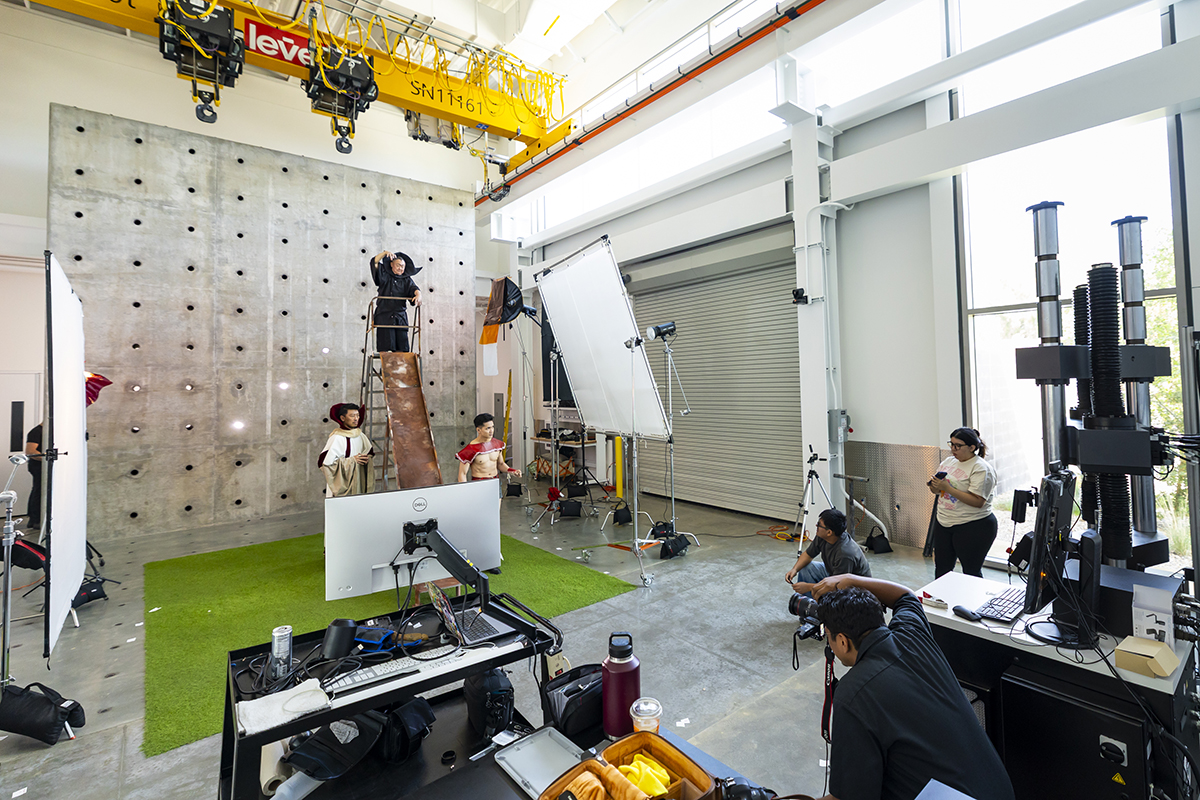
Dressed in a black tunic and collar as the supervillain Ming the Merciless, artist Bruce Yonemoto climbed the staircase to the top of a towering playground slide and struck an intimidating pose.
He loomed above two actors, one dressed as the athletic hero Flash Gordon and the other also dressed as Ming.
They were recreating a memory from Yonemoto’s childhood.
CSUN student photographer Oscar Jimenez clicked his shutter.
Career Pathways for Artists
Yonemoto is a world-renowned multimedia artist who often works in video and digital media. He was working on campus with students and faculty at California State University, Northridge on a new project inspired by games he played as a kid with his older brother, Norman. The brothers were artistic partners with video installations and other works in the 1970s and the 1980s. Norman died in 2014.
“I’ve been thinking about this project for a long time,” Yonemoto said a few days after the late March photo shoot. “So I’m very happy that I was able to produce this new body of work. It was amazing working with professors and students at CSUN.”
Yonemoto is this year’s Virginia A. Orndorff Artist-in-Residence, a special program in CSUN’s Department of Art and Design in the Mike Curb College of Arts, Media, and Communication. The semester-long program debuted last year, created by faculty, staff and long-time donors Virginia ’00 and Chris Orndorff to develop career pathways for student artists. Virginia Orndorff recently joined the CSUN Foundation Board of Directors.
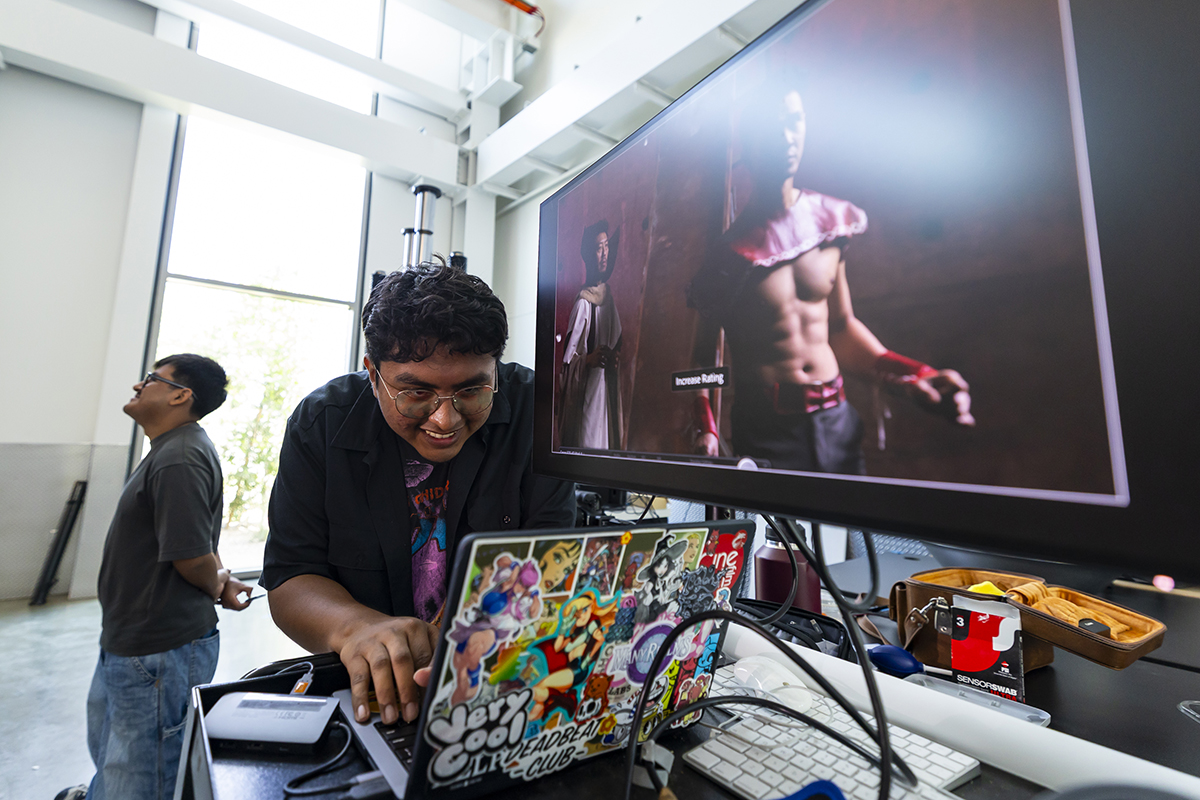
Yonemoto has been speaking to classes, meeting individually with graduate students, and bringing in guest artists for talks. The residency is tied into the curriculum of Professor Mario Ontiveros’ exhibition design course. Students from the exhibition design class served in production roles on set, as assistant director and helping with the lighting. Students also took pictures to document the process.
The exhibition will take place in the CSUN Art Galleries from May 2 to 21. The opening reception is May 2 from 3 to 6 p.m.
‘I Was Glad to Play Him’
The artist-in-residence pilot was originally funded for three years, but it already has been so impactful that the Orndorffs recently provided funding for a fourth year.
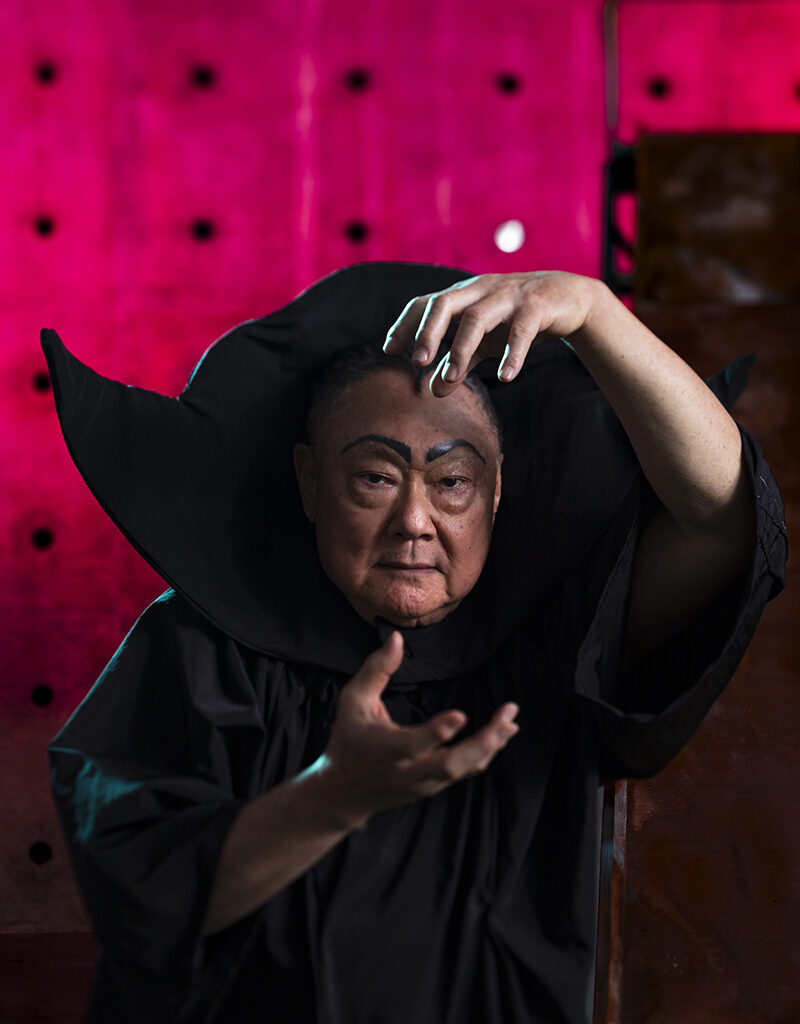
Yonemoto’s work explores experimental cinema and video art. It examines how mass media, including soap operas and TV commercials, influence perceptions of personal identity. In an article commissioned for the CSUN exhibition brochure, he told the writer Ana Iwataki that, for Japanese American families trying to assimilate after incarceration during World War II, mass media gave direct access to American culture.
The art installation he’s creating at CSUN honors his relationship with his brother while also highlighting the portrayals of Asian characters in popular American media.
As kids in the 1950s, Bruce and Norman would watch a black-and-white television, where they saw the serialized “Flash Gordon” movie from the 1930s. It starred Buster Crabbe as Flash. Ming the Merciless, a villain modeled on racist stereotypes, was played by actor Charles Middleton. Bruce and Norman would imitate these characters on their home playground.
“My brother, Norman, would always want to play Flash Gordon, because in many ways, he thought he was blond, even though he was Asian American, Japanese American,” Yonemoto said. “And so the only other main character that was left was Ming the Merciless, who was supposed to be Asian, but he was, of course, played by a white actor in yellowface.
“I was glad to play him because he had superpowers,” Yonemoto continued. “I remember I was probably 6 or so, climbing the backyard slide and giving proclamations from the top of the slide. And so I’m recreating this experience.”
‘Brutalist Playground’
Yonemoto conceived the project and directed it, relying on CSUN students and faculty for the work’s production.
“It touches every part of our department,” said Joe Bautista, chair of the Department of Art and Design.
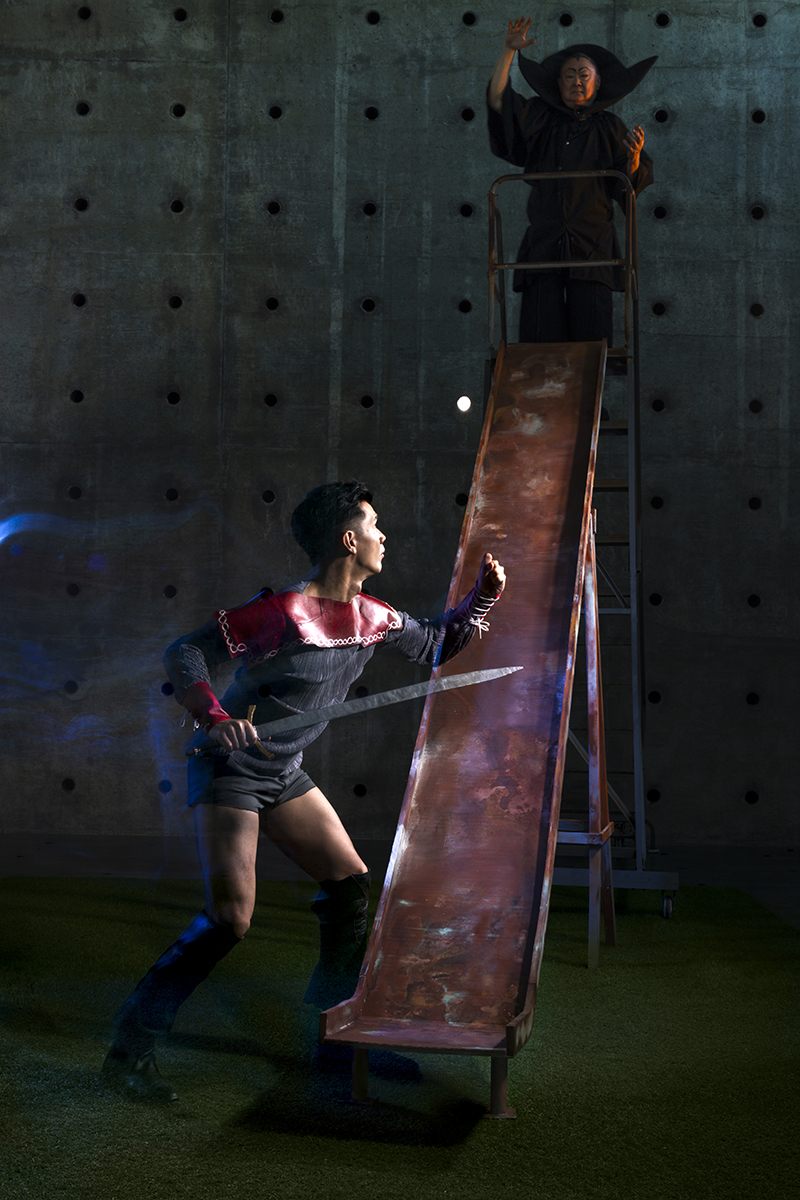
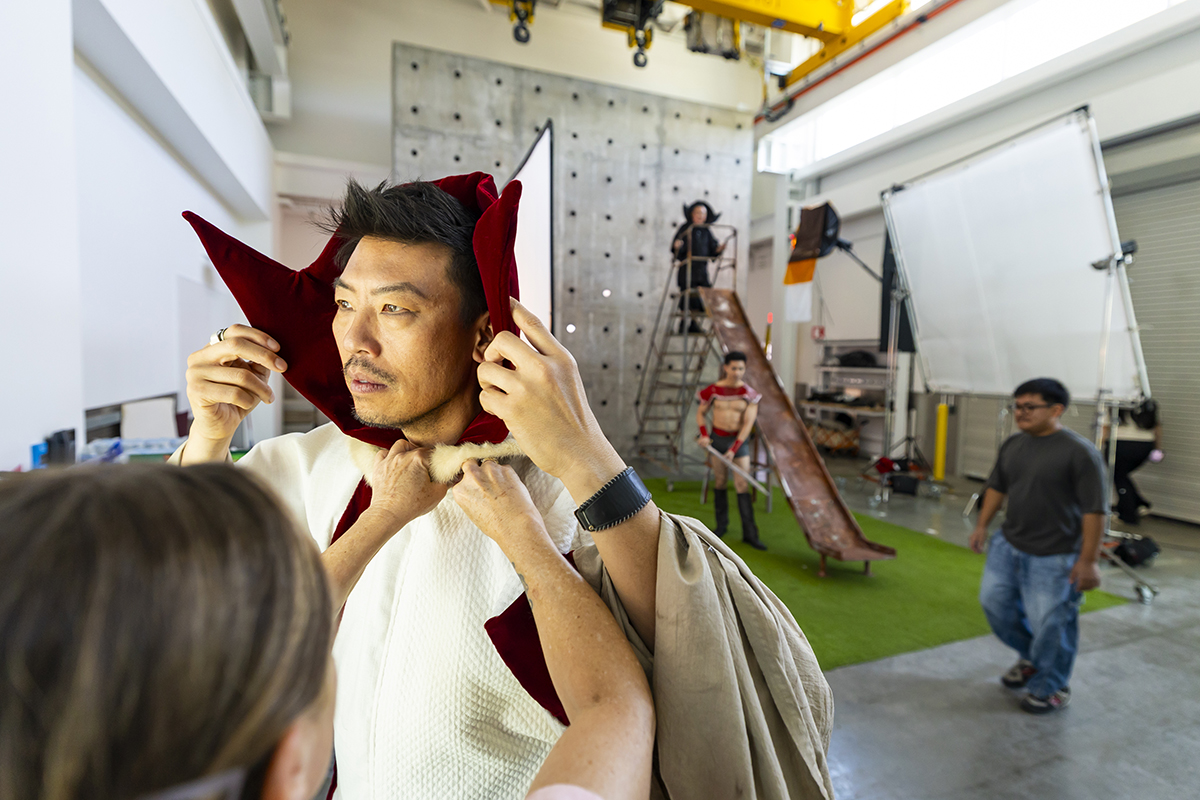
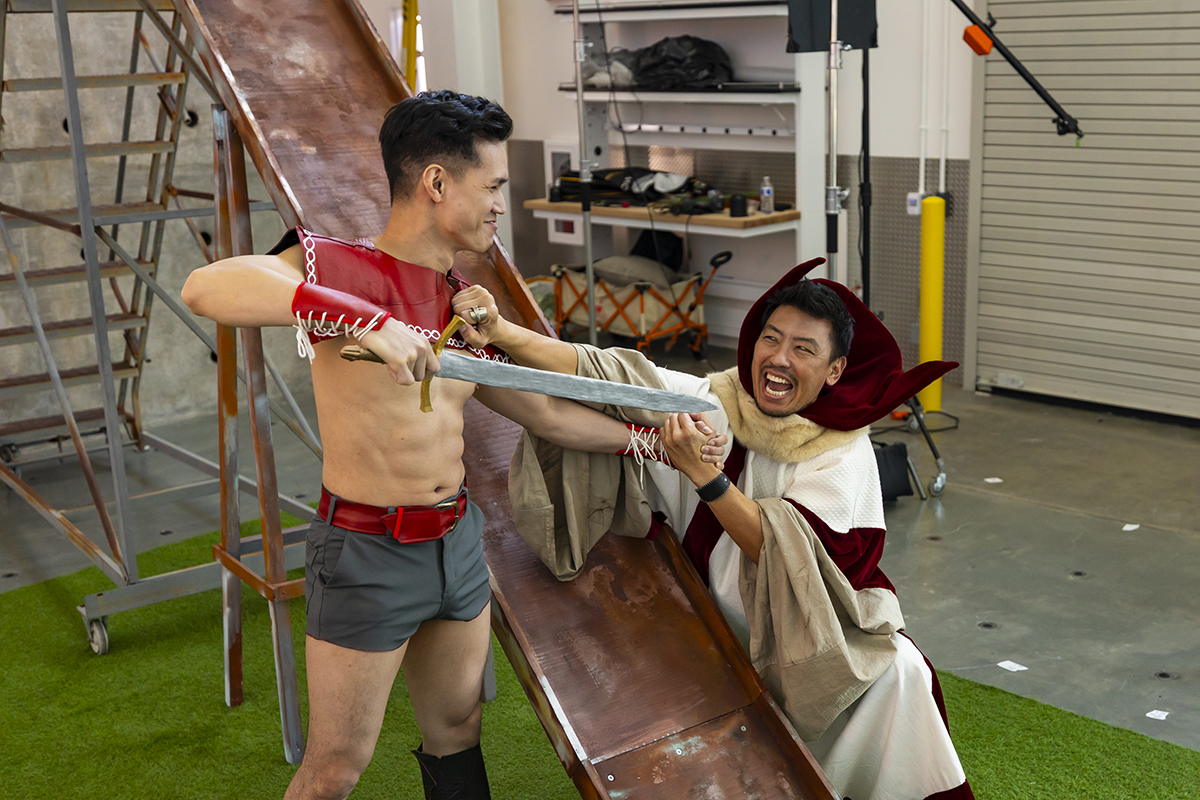
The team included professional makeup artist Katy McClintock and costume director Ella Frauenhofer. The costumes were inspired by original Ming Dynasty Chinese robes. Student Clover Kustack built a prop sword that Flash Gordon wields.
Yonemoto initially wanted to find a slide like the one he used to play on, but it proved impossible.
“These slides at that time were made out of metal and they were very heavy and they were very dangerous,” Yonemoto said. “They were totally eliminated. You cannot find them anymore because kids would fall off and die.”
To recreate the slide, Yonemoto used a 14-foot-tall industrial staircase that had been laying around the art and design department for several years. Professors Brian Dario and Sunyoung Lee built the slide portion out of cardboard, and worked with students to apply rusty-looking paint.
The photoshoot took place in the high-bay lab of CSUN’s new Autodesk Technology and Engagement Center, one of the few spaces on campus tall enough to accommodate the 14-foot-tall slide. The collaboration was an example of the collaboration between the Andrew J. Anagnost College of Engineering and Computer Science and other colleges that can happen in the new space. The shoot was set up on some astroturf in front of a 20-foot-tall reaction wall for stress-testing materials.
“That space was great,” Yonemoto said. “The wall added to it. It’s sort of a brutalist playground.”
Into the Ming-Verse
Yonemoto hired Taiwanese-born actor Todd Lien to play Flash Gordon in the photos. He chose photography faculty member Rollence Patugan to play Ming. Patugan is also an actor who had appeared in Yonemoto’s series “North South East West,” which explores the history of Chinese Civil War solders.
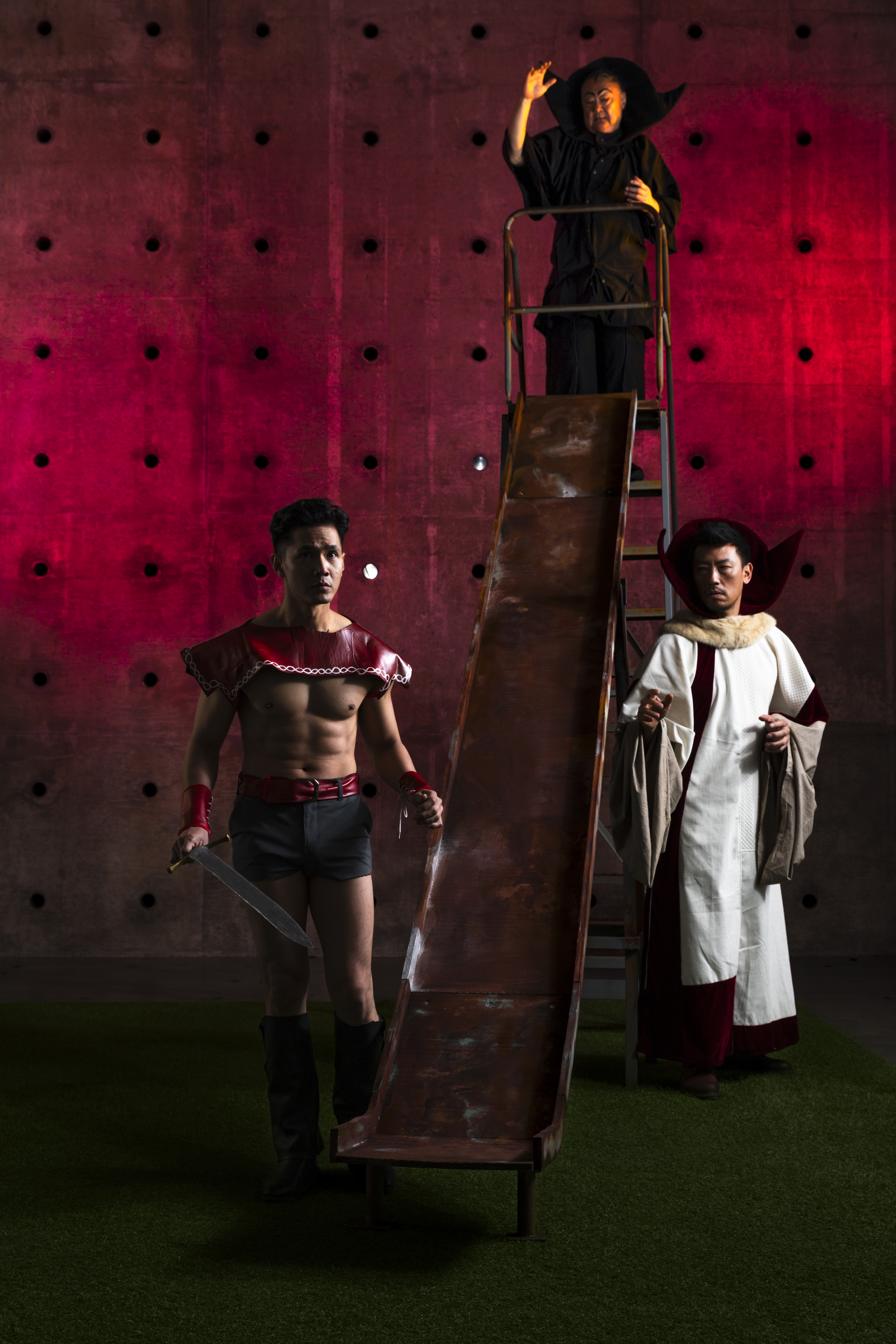
Yonemoto added himself as a second, older Ming at the urging of friends — the work was autobiographical, so he should be in it. He wasn’t sure how people would respond to the sight of him in costume. Maybe people would think it was funny, which he was OK with. Maybe they would think of the Spider-Verse, where multiple versions of the Spider-Man character can exist at the same time and place.
“I think it adds something,” he said.
While Yonemoto received a makeup application, Patugan helped students position and test lights and other equipment. He coached Lien, making suggestions on how to position himself to look good in the photos. You want to be here when the light bulb flashes. Tilt the sword this way so the lights glint on it.
Senior art major Lylit Barseghian is in the exhibition design class and worked on the set during the photoshoot.
“I never thought about this aspect of an exhibition, so it’s been really interesting to get to work with him, figuring out what we need and what he needs from us,” Barseghian said. “We have a very specific timeline, especially for his shoot, for the exhibition date and our class end date as well. So we have to manage everything in an orderly fashion.”
The shoot resulted in a series of images, including action shots of Flash and Ming fighting. The dark, moody look was influenced by the late German filmmaker Douglas Sirk. The exhibiton will include large, framed photographs, with a smaller slide sculpture by Lee and Dario.
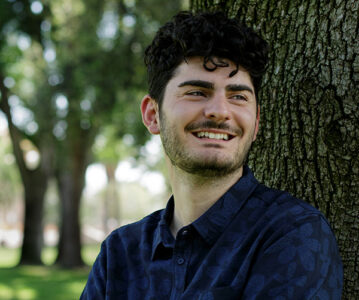
Graduate student Oscar Jimenez ’25 (Cinema and Television Arts) took the actual photos. Jimenez has spent the semester working as Yonemoto’s assistant, helping make the project shoot happen and participating in mood boards and other creative work. He’s a photographer who has learned a lot working with Yonemoto.
“I generally am really interested in this idea of recreating the past,” Jimenez said. “A lot of my work deals with memory and nostalgia as well, so it’s been interesting seeing a professional tackle that concept and see what ideas he brings up, and maybe stuff that I could think about within my own work.”

Comments are closed.