

On a clear and chilly Friday night, the darkest spot on the University Library lawn became a gateway to the cosmos for the curious: Everyone was invited to CSUN’s Star Party on February 20. About 150 people, bundled up in jackets, hats and gloves, showed up to the site where a dozen telescopes were set up, far back from the brightly lit library windows.
Nineteen student volunteers from the CSUN Society of Physics and faculty members from the Department of Physics and Astronomy in the College of Science and Mathematics were on hand to answer questions, keep the instruments in focus and guide visitors on how to look through the telescope eyepieces. Scarlett Andersen, a physics major, was one of the volunteers.
“Tonight my station is doing Jupiter and Rigel. I know that our other stations have the moon and Saturn,” she explained. Rigel is a supergiant star in the Orion constellation.
Computer science student Javier Herrera had heard about the event earlier that day — and brought his girlfriend’s brother, 8-year-old Liam.
“I thought of him because he loves the universe, and he watches videos on YouTube about every planet of the solar system,” Herrera said.
Over the next two hours, small lines formed at the stations as astronomy enthusiasts of all ages arrived and waited their turn. Mel Zernow, a physics teacher at Granada Hills Charter High School, was expecting some students from his astronomy class to attend. He made sure to stop at the telescope that was focused on the moon. The close-up view clearly showed the moon’s pocked and cratered surface — very different from the smooth glowing crescent visible to the naked eye.
“I always enjoy that, it’s beautiful,” Zernow said. “But the planets are pretty impressive.”
Sherry Bernardino, a Northridge resident, brought her seven-year-old son, who is currently learning about moon phases in school.
“He’s doing a chart, like a journal for the phases,” she said. “He’s fascinated with the moon, with satellites and celestial bodies.”
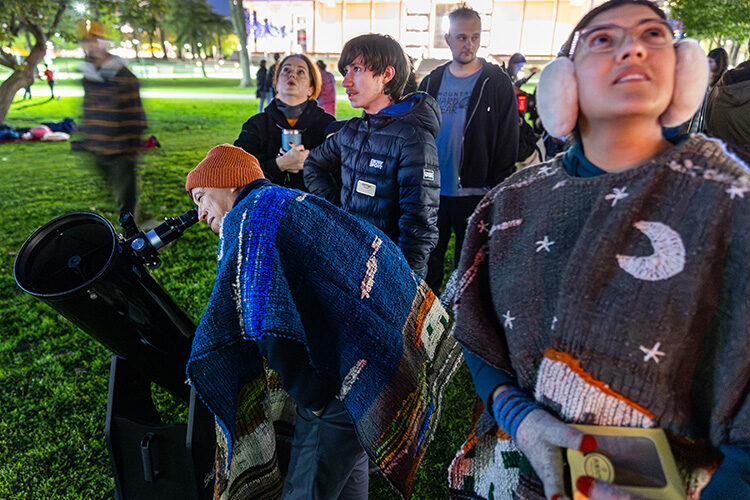
This was the second star party hosted by the department and the student group. Luca Ricci, a CSUN professor and astronomy researcher, said last year’s event drew about 500 people. He called it a “beautiful experience.”
“[This is] really coming out of a desire to share our passion for the beauty of nature to as many people as possible,” he said.
Ricci noted that thousands of people stopped by the Bianchi Planetarium when the department held a viewing event for the partial solar eclipse in April 2024.
“Basically, everybody on campus that day came to see the solar eclipse,” he said.
CSUN is one of a handful of public universities in the state that has a planetarium — which is an indoor theater where simulated star shows are projected onto a dome. It’s an educational experience that bypasses the whims of bad weather or light pollution.
CSUN’s Donald E. Bianchi Planetarium, named after the founding dean of the College of Science and Mathematics, first began offering public star shows in 2002. Department of Physics and Astronomy Chair Debi Prasad Choudhary explained that the facility, that’s located next to Citrus Hall in the center of campus, is due for renovation.
“The current projection system, audio-visual infrastructure, seating and control systems are outdated and no longer meet modern education standards,” he said. “The goal is to transform the planetarium into a cutting-edge immersive learning environment, while preserving its role as a campus landmark,” he noted.
Choudhary said the renovation will include installing a state-of-the-art full-dome digital projection system, upgraded surround sound and new seating, as well as refreshed lobby and exhibit space. The initial cost estimate is approximately $5 million. A fundraising campaign is already in progress — the goal is to begin the work within 12-18 months and re-open the planetarium in three years.
Choudhary said a renovated planetarium will significantly enhance teaching and learning across multiple disciplines — and will also serve as a vital community resource, including K-12 school visits, professional development workshops for educators and cultural astronomy programs. It will allow for even more community events like the star party.
“This will bring families, students and educators together to explore the universe and encourage the next generation of STEM leaders,” he said.
The campus is seeking out individuals with a passion for astronomy who have the financial support to help make this a reality. Please contact Tania R. Gabriel-Barca, director of development, College of Science and Mathematics, (818) 677-6308 or tania.gabriel-barca@csun.edu.



Comments are closed.