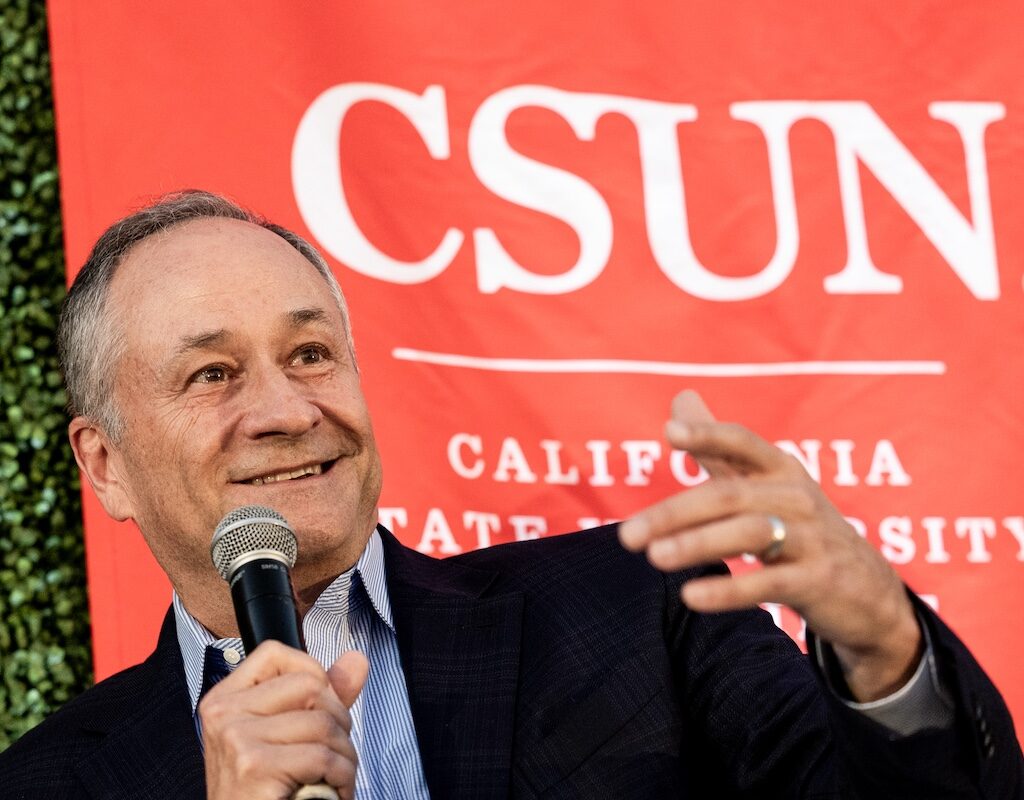
The first time Doug Emhoff spoke to a gathering of CSUN’s Mike Curb College Cinema and Television Arts (CTVA) students and alumni, just last summer, the challenges and opportunities of AI were a concern but not necessarily at the top of the list. Much has changed since then.
At a second gathering October 5, the former Second Gentleman and CSUN alumnus focused on questions about the impacts of AI on the entertainment industry. AI news moves fast.
A Los Angeles radio station now uses an AI DJ as a morning co-host, with other stations doing similar things across the country, noted Dan Hosken, dean of the Mike Curb College of Arts, Media, and Communication at California State University, Northridge. AI models continue to improve, raising questions about the work they can do and which workers might be pushed aside. Meanwhile, Hosken said, Pope Leo weighed in on the issue, saying, “it is becoming urgent to distinguish human art from what machines produce.”
“This is causing everyone to have these conversations probably a lot sooner than we thought we would,” said Emhoff ’87 (Communication Studies), former Second Gentleman and longtime entertainment attorney who also teaches law.
“People are now thinking about their place and what kind of world we want to be in, and it’s good,” he said. “It’s healthy. We can’t have other people dictate what our lives are going to be. We need to participate in that, and I definitely learned that in my time in politics.”
The Biggest Questions Surrounding AI and Entertainment
The “Entertainment Meets AI” event took place at the Penske Media Corporation Los Angeles headquarters atop the LUMEN West L.A. building, near Sawtelle. It was a chance for students and alumni at all stages of their careers, including many at the highest levels of the entertainment industry, to network. Members of CSUN’s Attorney Networking Group alumni chapter also were there to connect.

The featured conversation was between Emhoff and his longtime friend Jeff Schneider, executive director of the USC Gould School of Law Center for Sports, Entertainment, Media, and Technology Law. Schneider asked most of the questions, but also weighed in with his own considerable expertise.
Questions still loom about how AI will shape entertainment jobs and intellectual property rights. Emhoff recommended embracing it as a tool to augment, not replace, human creativity.
CSUN President Erika D. Beck said it’s critical to enable students with the ability to know when to use AI tools, how to trust their creative voices, and how to grapple with ethical and legal questions. She believes people will always value the connection between artist and audience.
Emhoff’s Relationship with CSUN
Since leaving Washington, D.C., Emhoff has been a visible presence at CSUN. He wants CSUN’s entertainment alumni to have the same kinds of connections he made through his other alma mater, USC Gould School of Law. The two events with Mike Curb College students, faculty and staff help make these connections.
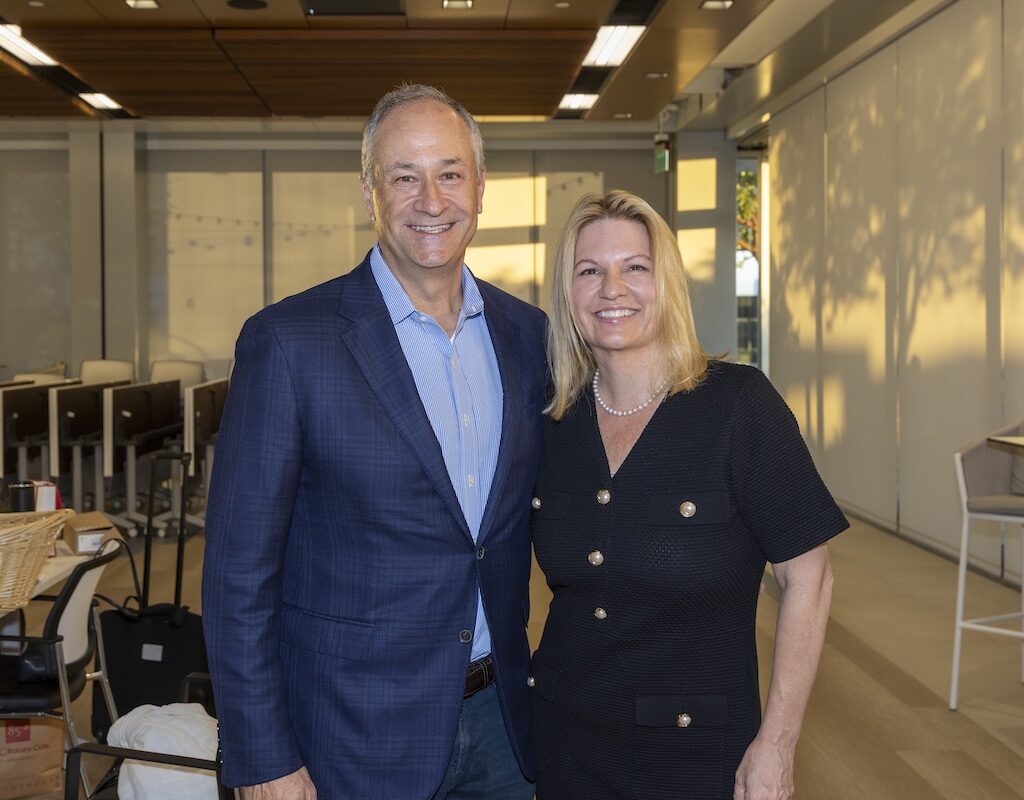
Emhoff was also the keynote speaker at this year’s Honors Convocation ceremony May 9. His longtime support of CSUN includes making frequent philanthropic gifts.
Often, he speaks about how CSUN laid the foundation for his future success. His film studies classes at CSUN shaped his career, he said.
“I really loved learning about film from an intellectual standpoint, and it really helped me fall in love with this business,” Emhoff said. “And I don’t think I would have had the same passion to work so hard to become an entertainment lawyer.”
What Did Emhoff Say About Using AI?
Speaking from his vantage point as a practicing entertainment attorney, Emhoff said he encourages his firm’s junior attorneys to use AI in their work. Using AI to do background work frees the team to do the higher-level strategizing necessary to win cases, he said. But he emphasized that it’s important to fact-check everything.
Emhoff believes that audiences will always have an appetite for stories well-told by humans. He noted the recent box office successes of movies such as “Obsession,” “The Odyssey” and “Spider-Man: Brand New Day.” There’s also demand for smaller-scale content that provides human connection, like podcasts and documentaries, he said.
The extent of AI’s impact on film and TV jobs remains to be seen, he said. From where he sits, the biggest impact could come to the employees who handle special effects, set design and other production tasks, he said. It’s possible that these roles evolve into jobs with newer responsibilities. He said it’s important for CSUN to prepare students for the jobs of the future.
“So, bottom line on AI: net positive or net negative for artists, long term?” Schneider prompted.
“It’s the wrong question, because it’s not going anywhere,” Emhoff said. “You’re going to have to, as an artist, deal with it, one way or another. You’re either going to embrace it or reject it. Others are going to be using it, so I think it’s here. It’s not going anywhere. So, if you’re a creator, you’re going to have to figure out your place.”
Building the Future We Want
In recent weeks, an increasingly loud chorus of employees from AI companies have warned that the technology threatens humanity, perhaps in the next five years.
Emhoff said that there is a push for public policy for better guardrails and accountability for companies for the products they make. But we can’t leave solutions up to any one sector, he said.
“That’s on all of us,” Emhoff said. “No, you can’t be looking only at Congress or only at the [AI] companies. This needs to be one of these all-hands-on-deck, public-private partnerships to make sure that we’re safe, it progresses in an orderly way, and we’re able to use it for good, not for bad.”
As the entertainment industry continues to change, CSUN’s mission will be to train students to be adaptable, Emhoff said. He believes the Mike Curb College is up to the challenge.
“I was there last year. I saw the facilities — they’re incredible,” he said. “You’re training people who do every type of job there is. And if behind-the-scenes [jobs] do morph more to AI, then make sure we are training folks here to have those jobs.”