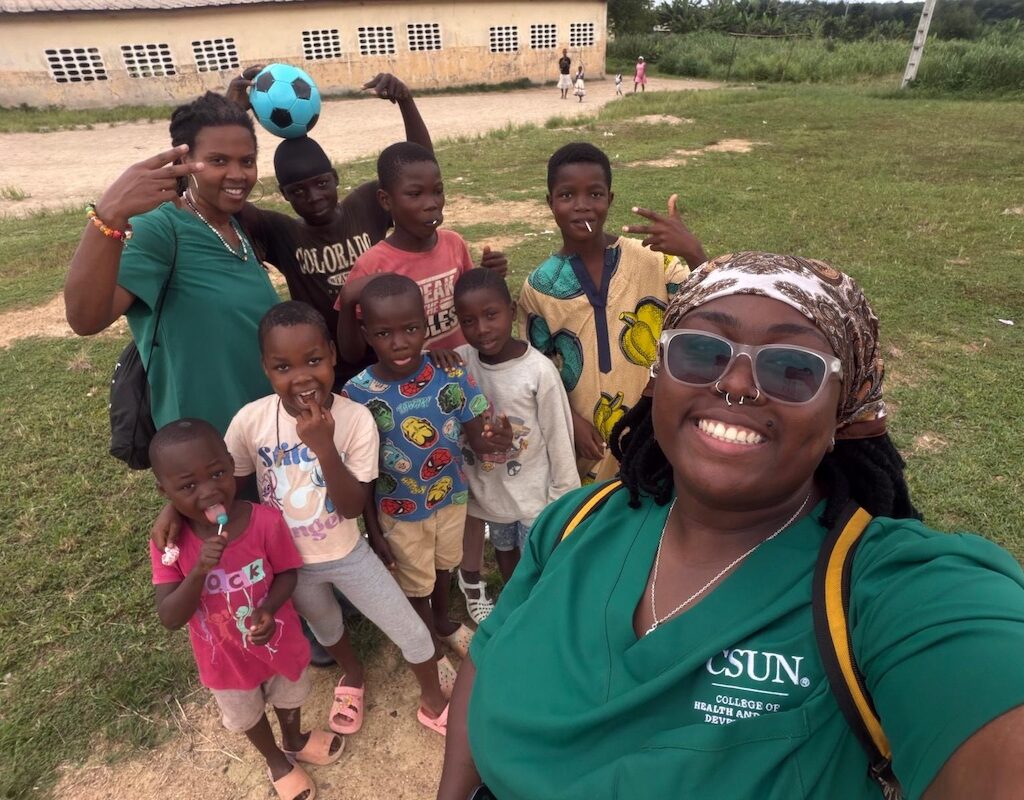
The lessons from Shondrea Wooden’s public health classes took on new clarity as she and other CSUN students interned at a maternal and child health clinic in a rural village in Côte d’Ivoire.
It was clear that the community’s way of life impacted delivery of health services. Many women in the country work, so health clinics take place on Tuesdays, a designated day off. And with few people owning cars, a Tuesday rainstorm could keep many people away.
“Just seeing how those things affect people’s access to, and willingness to access, care in a setting other than our own was definitely interesting and eye-opening for sure,” said Wooden, a fourth-year public health major.
Wooden was one of three students in the College of Health and Human Development at California State University, Northridge who traveled to Côte d’Ivoire, West Africa, for a public health-focused internship.
The three students interned at the Ivory Coast Mothers and Children – Patricia Nau Clinic, a community-based maternal health clinic in Braffouéby. Braffouéby is about 90 miles southeast of the country’s official political capital, Yamoussoukro, and 50 miles northwest of the financial capital, Abidjan, the coastal city that the CSUN contingent flew into and stayed in for a week. The students were there to observe how professionals addressed their community’s specific needs with the resources available. They also participated in a small research project that could guide future public health decisions in the region.
“These are life-changing opportunities that don’t come by often enough for students, and the same for the faculty who were able to go with them,” said Mechelle Best, dean of the College of Health and Human Development. “I am so proud of our students for seeing this as an opportunity.”
Why an International Internship in Public Health Is Important
Côte d’Ivoire is on the southern Atlantic coast of West Africa. Its official language is French. The rural village of Braffouéby is tropical, with fruit trees all around, and cows and chickens roaming free. Farmers grow cocoa, coffee and rubber. Students and faculty members described it as safe, welcoming and generally clean.
“It’s so beautiful there,” Wooden said. “It looks like a painting everywhere you look.”
The internship was made possible by a $150,000 grant from the UniHealth Foundation, which supports community-based health organizations in Southern California. UniHealth, which previously has invested in the College of Health and Human Development, was interested in supporting an internship with the college, Ivory Coast Mothers and Children, and the American Women for International Understanding (AWIU). AWIU is an organization that connects women in the United States to other countries to build bridges of understanding and collaboration.
The goal was to immerse healthcare students in another culture, which would change their perspectives and make them better medical professionals.
“It changes the way you think about yourself, your identity, your power, the way you interact with people, what culture is, and if it’s a meaningful experience, it creates a whole lot of humility,” said Jen Vanore, president and CEO of UniHealth Foundation. “I know this will be a game changer for the students as they enter into their careers.”
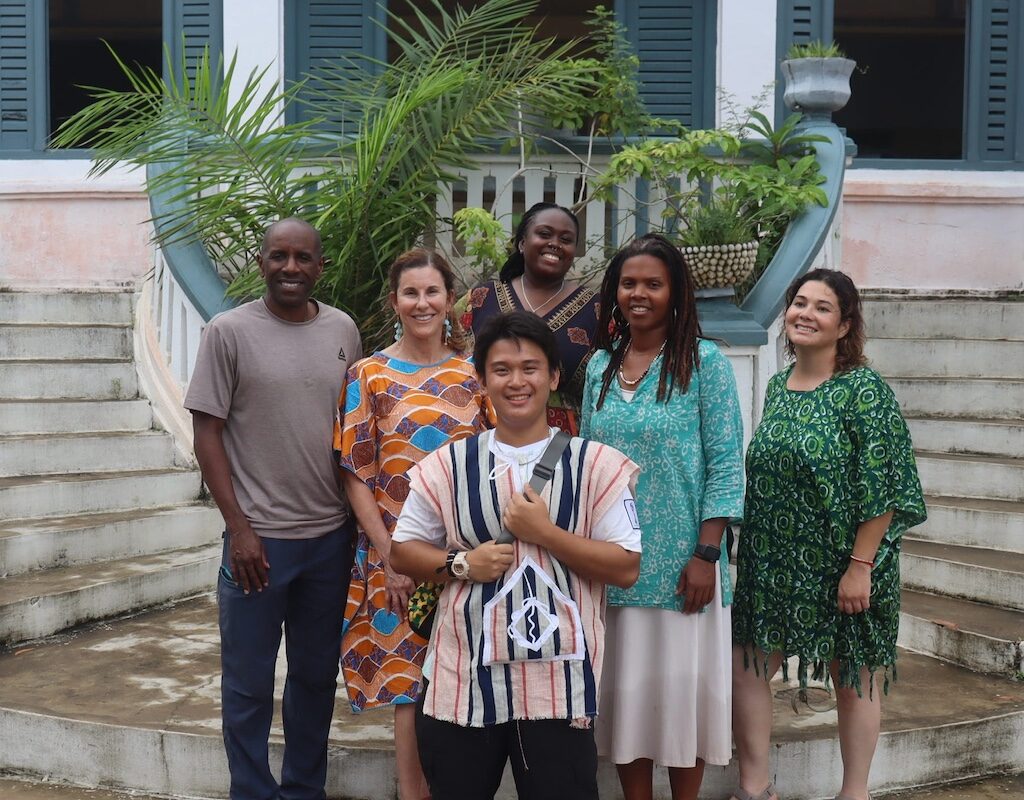
The three students were selected from a pool of more than 30 applicants. Two were public health students — Wooden and Melissa Magaña — and the third, Seth Ceballos, is a major in environmental and occupational health.
Three professors traveled with the students as advisors — Kacie Blackman (health sciences), Dena Herman (family and consumer sciences) and Ivan Guillory (kinesiology).
After they were selected, the students enrolled in a CSUN French class. They also worked with a French tutor.
AWIU also helped prepare the students for seven weeks in a country they’ve never visited, with a language they’ve never spoken.
“Something that we’ve been talking about for sure is, how do we provide more opportunities for youth and more opportunities for you to travel abroad and see the world and be transformed by it,” said Miranda Cohen, AWIU executive director. “It changes your life. It changes the way you work, the way you operate, the way you see things.”
Finding a Safe Community to Live and Learn
The CSUN group made clear that they were there to learn, not to dictate or judge. Community members were quick to welcome them.
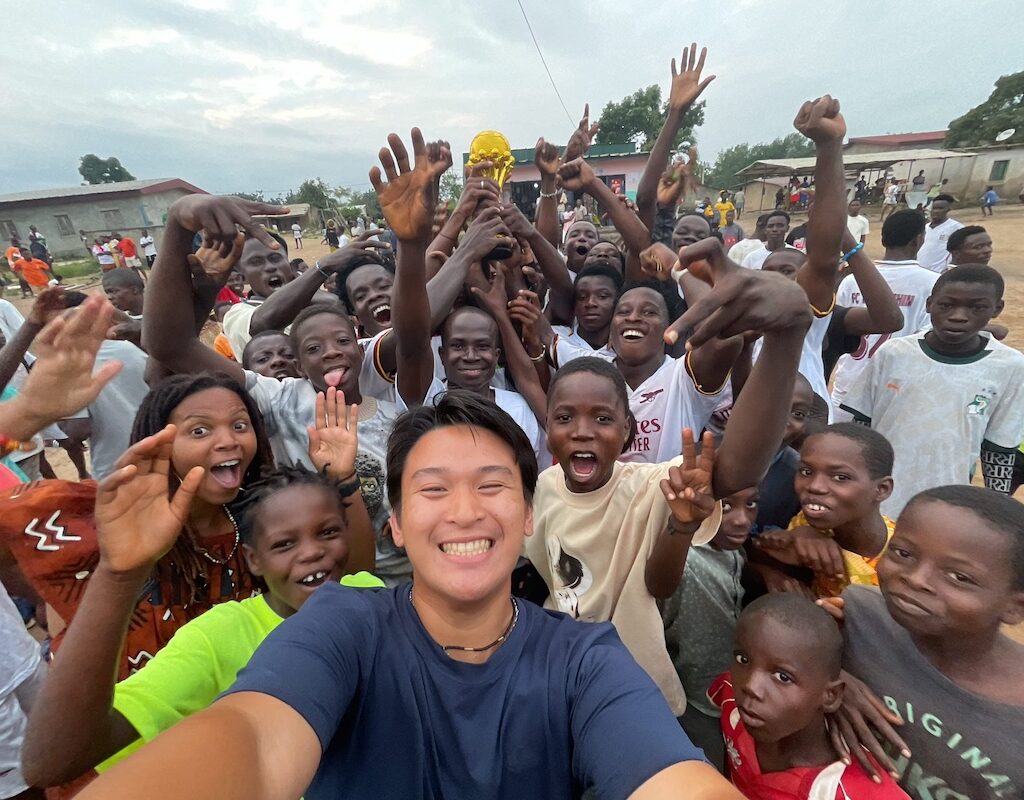
The college rented two houses for the students and faculty members to stay. The Côte d’Ivoire men’s national team was playing in the World Cup, and students and faculty watched games with community members.
“They were so inclusive, so welcoming,” Blackman said. “You felt like you belonged. The sense of safety was evident and present.”
Despite language barriers — Google Translate was a lifesaver — meaningful connections were established. Magaña recalled taking care of a baby while its mother was getting a vaccination.
“My most meaningful experience was holding a 6-month-old baby in my lap while she was teething and fussy,” Magaña said. “I spoke and sang to her in Spanish, and she smiled and cooed and giggled. That moment taught me that care doesn’t need any common language.”
Students Explore Public Health in a Foreign Country
The Patricia Nau Clinic advances medical care for safe births and access to disease treatment and prevention, especially for mothers, newborns and children under 5.
The clinic has a maternity section, a general health section, a pharmacy, a lab and a vaccination clinic. The students observed professionals including maternity nurses and midwives, as well as student nurse interns from Cote d’Ivoire.
In addition to weekly vaccination clinics, the students observed a day when staff traveled to four nearby villages and vaccinated more than 300 children.
Wooden went to the pharmacy to learn what medications they carried. (One difference: They stocked many medications for malaria.) Wooden also observed work in the lab, where they process tests for malaria, gestational diabetes, kidney function and other conditions.
Ceballos took the opportunity to look at the clinic through an environmental health and safety and public health perspective. He took on a side project working with a sanitation professional in the village to observe water quality at various sites.
He spoke to the clinic leadership and learned directly from them about the decisions they’ve made.
“That was important to me because it allowed me to understand that the issues we discuss in class aren’t always as simple when addressing it,” he said. “There are financial limitations, infrastructure limitations, available resources, staffing and other priorities that organizations have to balance.”
Laying the Groundwork for Future Public Health Research
While healthcare conditions in the nearby coastal city of Abidjan had been studied, the village hadn’t been studied much. Blackman and Herman led a project to contribute new information.
They asked women to compare their experiences at the Patricia Nau Clinic to clinics in Abidjan — including wait times and quality of treatment. Questions also addressed support for mental health like postpartum depression. Other big questions: Where do you get your information from? How do you know what’s right or wrong when raising your baby?
The students also interviewed staff including the clinic director, the lab technician, the pharmacy staff and others.
Blackman said the work produced viable research and laid the groundwork for future collaboration. It took time to build a relationship with community members, decide what questions to ask and translate the questions using the nuances of the local dialect.
“Because we established this connection, I think future research will be easier,” she said.
CSUN Students Return with a Deeper Commitment to Community Health
Patsy Mertz, the founder of Ivory Coast Mothers and Children, recently visited CSUN’s campus for a presentation from the students about what they did, what they learned, and what they will carry forward in their lives and careers.
“My heart’s full,” Mertz said. “Your kindness lives on in the village. They are so appreciative of you and the work that you did.”
The internship experience reinforced the importance of public health and opened up new options, Wooden said. She’s now interested in teaching English abroad. She also wants to become a doula to decrease the maternal death rates in the Black community.
“This internship definitely reinforced my passion for public health and reinforced my future career goals,” she said.
Magaña said she would continue to explore mental health and children’s health, plus disease prevention and health equity.
“I’m more committed to pursuing a career in community-based health, working with the underserved populations, both locally and maybe globally,” Magaña said. “I also want to continue to learn French, so that I can better communicate across differences and to honor the people I met who welcomed me into their lives.”
Ceballos said the internship experience gave him a deeper understanding of the possibilities that come from working with people of different backgrounds. He’s still in touch with clinic staff, exchanging information and ideas. He wants to become a travel nurse, working alongside healthcare providers from different countries.
“This felt like a once-in-a-lifetime thing, but I want to do it again,” he said.