

Media Contact: Nicole Diaz, nicole.diaz.545@my.csun.edu, or Javier Rojas, javier.rojas@csun.edu, (818)-677-2130
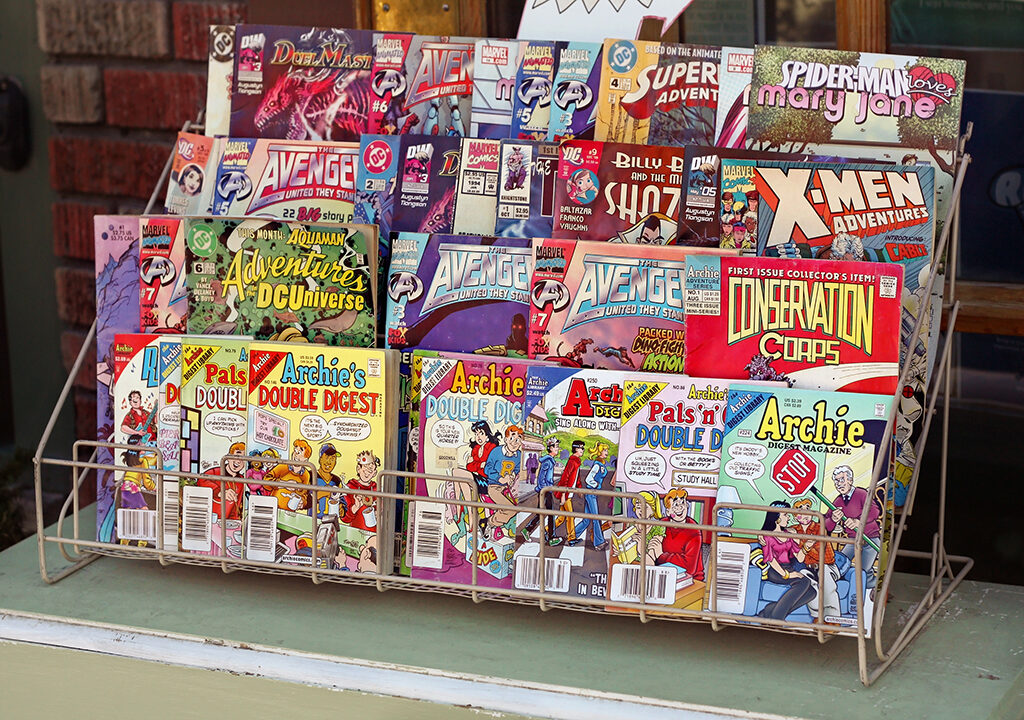
Comic books can meld graphic design, art and writing into a unique reading experience.
For the past 20 years, California State University, Northridge English professor Charles Hatfield has been introducing students to comic books of all types: alternative comics, mainstream comics, zines and others. His classes apply literary analysis to comics while analyzing other media comics to interact with and studying their impact on pop culture.
“A virtue comics have is that they make reading strange again,” said Hatfield, who co-founded and served as the first president of the Comics Studies Society from 2015 to 2018, the U.S.’s first professional association for comics scholars and teachers. “Comics of all kinds, whether they’re webtoons, or short comics strips you might encounter in the newspaper…whether the comic you’re reading is shorter or longer, whatever their form, they’re kind of an adventure in reading.”
The adventure in reading extends past the physical pages as fans curate a space to express themselves through the characters they love in various ways, Hatfield said.
Hatfield has written and coedited numerous books on comics such as “Hand of Fire: The Comics Art of Jack Kirby” (2012) and “Alternative Comics (2005), Comics Studies: A Guidebook” (2020) and “The Superhero Reader” (2013). He also curated one of the largest-ever exhibitions of Jack Kirby’s original art in 2015, “Comic Book Apocalypse: The Graphic World of Jack Kirby” at the CSUN Art Galleries.
“People are making fanfic, fanart, cosplay, terrific craftsmanship,” said Hatfield. “They are sort of owning or trying to reclaim ownership of these narratives, and the images that have moved them.
“I always think of Galactus walking across the exhibit floor in San Diego Comic-Con with Pikachu in his hands,” he continued. “Some people will reclaim ownership by turning and telling their own individual story in a way that will take everybody by surprise. And that’s what I’m really in it for: to see personal work that takes me by surprise.”
Although at surface level, comic books are known to be action-packed stories of fantastical superheroes, they can also be profound, telling true-to-life stories, said Hatfield, noting that comics are often reflections of people’s real-life struggles.
“It sneaks up on people in my classroom because they expect comics to be entertaining but not that potent,” he said. “But when you read work that is rung from people’s lives, it really can go through you.”
Hatfield said comics are not limited to the large popular franchises such as Marvel and DC, but also independently distributed by artists who have created their own stories with different available mediums. Whether online through webtoon, social media platforms or physically with zines and at smaller conventions and festivals, which Hatfield frequents and encourages students to attend.
“That’s the cool thing about comics,” said Hatfield. “That’s why my favorite comic show is Comic Arts Los Angeles, which is not San Diego Comic-Con size … but it’s a makerspace. You go there just as a reader and a fan, and you get to talk to people who have made stuff and they’ve put all their life into making this stuff.”

Comments are closed.