Media Contact: Carmen Ramos Chandler, carmen.chandler@csun.edu, (818) 677-2130
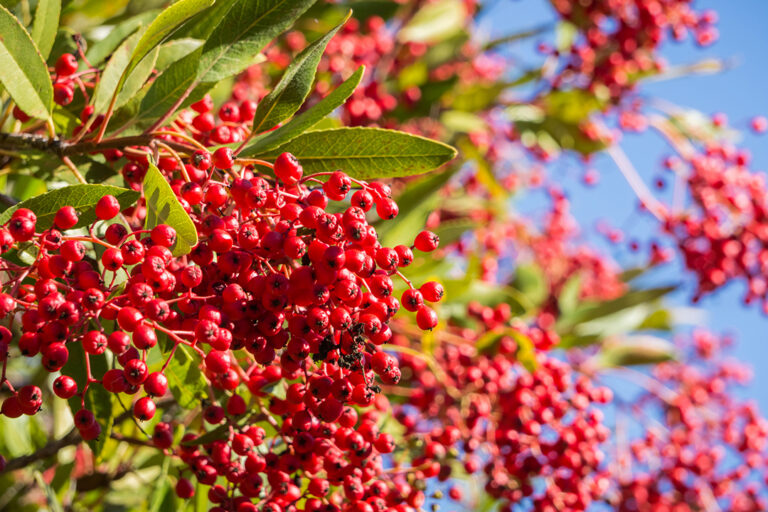
With the help of their own TARDIS, California State University, Northridge environmental biologists have been studying climate change’s impact on the state’s iconic toyon plants — popularly known as “Christmas Berry” or “California Holly” — to get an understanding of chaparral and oak woodland communities’ resiliency.
What they found is that while toyon has experienced variations in its habitat quality over the course of 125 years, most populations remain healthy. That gives researchers Jeremy Yoder and Daniel Dakduk hope about the future of other members of California’s chaparral and oak woodland communities.
“Toyon is a keystone, or foundational, species, in our oak woodlands and chapparal,” said Yoder, who teaches in CSUN’s Department of Biology in the College of Science and Mathematics. “Knowing how it is experiencing changing climate tells us something about how the larger plant community might be dealing with things. If the toyon is doing well, we’re hoping that its natural, indigenous plant neighbors are also doing well.”
The study, “Temporal analysis of reproduction distributed in space illuminates the climate-change resiliency of toyon (Heteromeles arbutifolia),” was published last month in The American Journal of Botany. The project was started by Dakduk while he was an undergraduate student at CSUN.
Dakduk took a modeling methodology developed by Yoder called TARDIS, “temporal analysis of reproduction distributed in space,” to understand the health of the toyon.

Yoder developed TARDIS to study Joshua tree populations across California, Nevada, Arizona and Utah. The analysis uses machine learning models trained on data collected by members of the public who capture photos of a particular species and upload them onto the smartphone app iNaturalist to paint of picture of what is happening with a species across time and space. The methodology’s name was inspired by British science fiction television’s “Doctor Who,” who travels across time and space in a blue police box known as the TARDIS, which stands for “Time And Relative Dimension in Space.”
“What our TARDIS does is take advantage of the power that we get if we have data about a plant’s population status distributed across time and space,” Yoder said. “Photos from iNaturalist records tell us whether a plant is flowering or whether it’s bearing fruit or whether it’s not doing anything. There are thousands of them for many species, and they all add up.”
Using photos taken between 2008 and 2025 across toyon’s range from the Bay Area to San Diego, Dakduk and Yoder were able to link that information to weather data for those years and locations.
“We can then use that information to train a machine-learning model that predicts whether or not weather conditions are suitable for toyon to flower,” Yoder said.
The researchers asked TARDIS to review historical weather data and determine the conditions for toyon health going back decades.
“We did that for over the span of the whole 20th century, from 1900 to present day,” Yoder said. “There’s been pretty substantial global climate change since then. On a global average, it’s about a degree and a half centigrade warmer than it was at the beginning of the 20th century. We used TARDIS to ask how that change in the weather impacted the conditions that toyon was experiencing and how that impacted its opportunity to reproduce and renew their populations.”
Armed with that information, Yoder and Dakduk then considered toyon’s future.
“What we learned suggests that, for the most part, places that are suitable for toyon will probably remain suitable for toyon, which is good news,” Yoder said. “For the most part, across most of the range of the species, there hasn’t been a great deal of change in the frequency or intensity of flowering.”
However, the researchers did find some interesting patterns, including the fact that toyon were not moving north to avoid some of the effects of climate change.
“If a species is being impacted by climate change, you expect that conditions suitable for it are going to shift north and uphill because that’s where it’s cooler,” Yoder said. “We would expect to see that flowering intensity is maybe more stable or increasing if you go further north. In toyon, we’re not seeing that pattern. With conditions overall being pretty stable, maybe that’s not a concern.”
Overall, the findings of the study were good news for the toyon and other chaparral plants, Yoder said.
“On average, populations of toyon are going to be doing about the same, but they’re experiencing bigger fluctuations from year to year that could make things a little less stable,” he said. “To the extent toyon are representative of other important chaparral shrubs like California lilacs and greasewood, the news is pretty hopeful for those plant communities as they share a lot of ecological and physiological features. We might see something similar to toyon for other chaparral shrubs.
“But everyone has a different biological story,” Yoder continued. “One thing we do see consistently in studies is that there may be shifts in the composition of California’s plant diversity because of climate change.”