Media Contact: Carmen Ramos Chandler, carmen.chandler@csun.edu, (818) 677-2130
In a laboratory in the basement of California State University, Northridge’s Eucalyptus Hall, associate professor of physics Sattar Taheri-Araghi and his students are setting out on an ambitious project to understand how antimicrobial peptides act under conditions that closely resemble real infections.
What they learn about the antimicrobial peptides — which are part of the innate immune system of multicellular organisms such as humans, animals and plants — could provide a roadmap for the medical community for understanding how to effectively use antibiotics and other antimicrobial agents to tackle serious infections in people. Taheri-Araghi, who teaches in CSUN’s College of Science and Mathematics, has received a $600,000 award from the National Institutes of Health (NIH) to support the effort.
“Usually, these types of projects don’t get funded because there’s a risk factor to it,” he said. “What we’re doing is not following classical methods of experimentation because we’re trying to focus on something very specific. We are trying to understand what happens in the body during an infection, when conditions for bacteria are not ideal.”
To support this research, the NIH grant includes funding for four undergraduate and graduate students each year over the course of four years to participate in the research project.
Taheri-Araghi explained that most established protocols study “live, happily replicating cells under so-called ‘steady-state’ conditions.”
“That is the standard way of doing many biological experiments,” he said. “But we want to figure out what happens in our body. Bacteria that are causing an infection are not in a perfect environment. They are in parts of the body where nutrients are limited. They are not in culture tubes growing happily. They are in a very special situation.”
“We know that the way antimicrobial agents impact bacteria does depend on the environment they are in,” Taheri-Araghi said. “We are trying to simulate important aspects of a real infection inside an experimental setting and then test how the antibiotics work.”
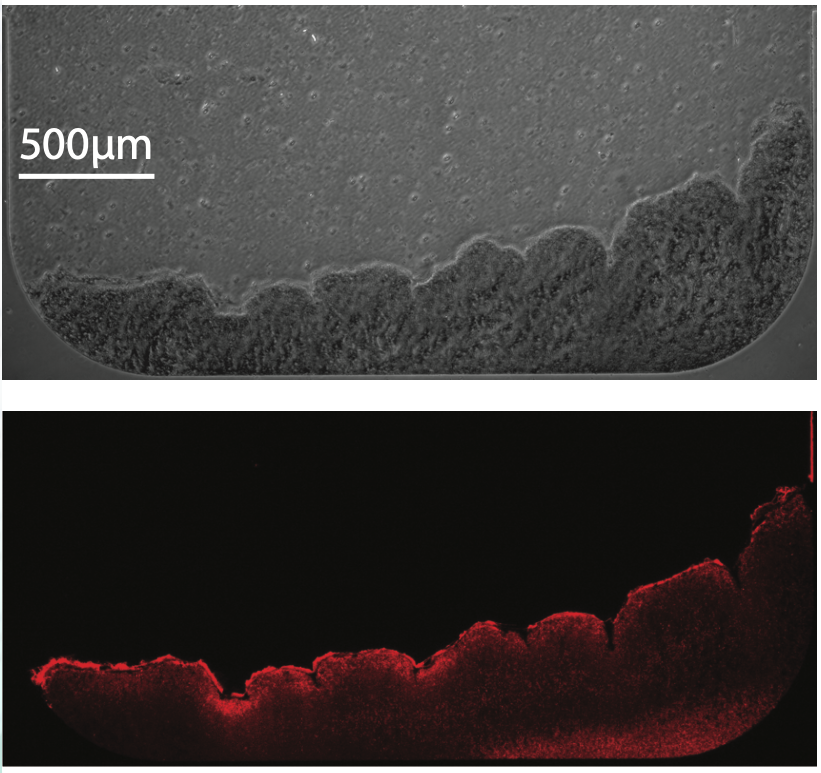
Taheri-Araghi’s lab is equipped with different types of microfluidic platforms in which he and his student researchers can trap bacteria and precisely control growth conditions, density of cells, and the nutrients delivered to those cells.
“We are engineering devices that, in a controlled way, can put cells under specific densely packed and low-nutrient conditions that simulate important aspects of an infection, and then study what happens,” he said. “These systems allow us to observe bacterial responses with high precision, in some experiments with single-cell resolution, and investigate how antimicrobial treatments behave in complex environments.”
“We’re looking at susceptibility,” he continued. “An antibiotic dosage that may look effective in a traditional experimental setting may not be as effective against a dense community called a biofilm — in which bacteria stick together and grow as a film on a surface — that is more resistant to certain antimicrobial agents.”
At a more basic level, as a physics professor, Taheri-Araghi said he also wants to understand the physics of what is happening “to have a good idea of how antibiotics can penetrate and distribute within a bacterial population.”
Part of the grant’s funding is focused on understanding how drugs are distributed in a bacterial population and how they penetrate dense bacterial communities.
“If we understand how antimicrobial agents distribute, then it helps us—or those in the medical community—design more effective therapies to treat a patient,” he said.
Taheri-Araghi said the grant presents a wonderful opportunity for his student researchers to be part of research that could be laying the foundation for future medical breakthroughs.
“I’ve had students who have worked with me on a voluntary basis for their research thesis, but they are limited in how many hours they can work in the labs and the demands on their time because so many of them also have to work in addition to their schoolwork,” he said. “This grant provides funding so they can cut down on the hours they are working elsewhere and to focus on their research, research that they can build upon as they continue their studies in graduate school and their careers as M.Ds. and Ph.Ds. or whatever career they choose.”