Trailblazing labor leader and civil rights activist Dolores Huerta, who co-founded the United Farm Workers and inspired generations to fight for social justice, had a decades-long relationship with California State University, Northridge. She visited campus and spoke with students, and her life’s work has a lasting presence in the university’s historical archives. In 2002, she received an honorary degree of Doctor of Humane Letters, recognizing her efforts to connect CSUN’s community to the movement that she championed throughout her life.
Following Huerta’s death on October 28, at 96, CSUN President Erika D. Beck noted the enduring legacy left by the lifelong advocate for justice.
“Across a lifetime of service, Ms. Huerta’s voice, courage and tireless organizing carried the cause of farmworkers, women, immigrants and working families,” Beck said. “‘Sí, se puede’ was her gift to everyone who believes change is possible. Its echo is still heard on our campus and in communities across the country. Our hearts are with her family, and with the Dolores Huerta Foundation, as we mourn her loss together.”
In 1995, Huerta came to CSUN to speak at a conference on campus, as part of the California Farm Workers Oral History Project. The speech is part of extensive documentation in the Tom and Ethel Bradley Center and special collections in the University Library that include photographic and oral histories and highlights of Huerta’s work.
During the speech on campus, Huerta referred to the university’s history for championing civil rights that brought about CSUN’s Chicana/o Studies and Africana Studies departments.
“You know, Northridge is … to Southern California what Berkeley is to Northern California, right? This is the Latino Berkeley right here, you know,” she said.
She spoke about what it was like to work in the farm worker movement and invited those present to take part, to learn more about the organizing efforts to create better working conditions for farm workers.
“Come with us to the fields… You’re doing a lot of phone calling, a lot of leafleting, a lot of visiting, some picketing, a lot of marching… But when you do that, then [you] learn how to develop your muscles,” she said.
Huerta, who moved to California’s Central Valley as a child, began her career as a labor organizer in 1960, when she helped establish the Agricultural Workers Association, working with Larry Itliong. In 1962, she co-created what eventually became the United Farm Workers organization that led boycotts and marches to bring worldwide attention to low wages and dangerous working conditions in the fields.
When Huerta was awarded an honorary degree at CSUN, it was noted that students had gone to work as interns with the UFW — many working in the “la escuelita,” the small school in Delano, attended by children of farm workers.
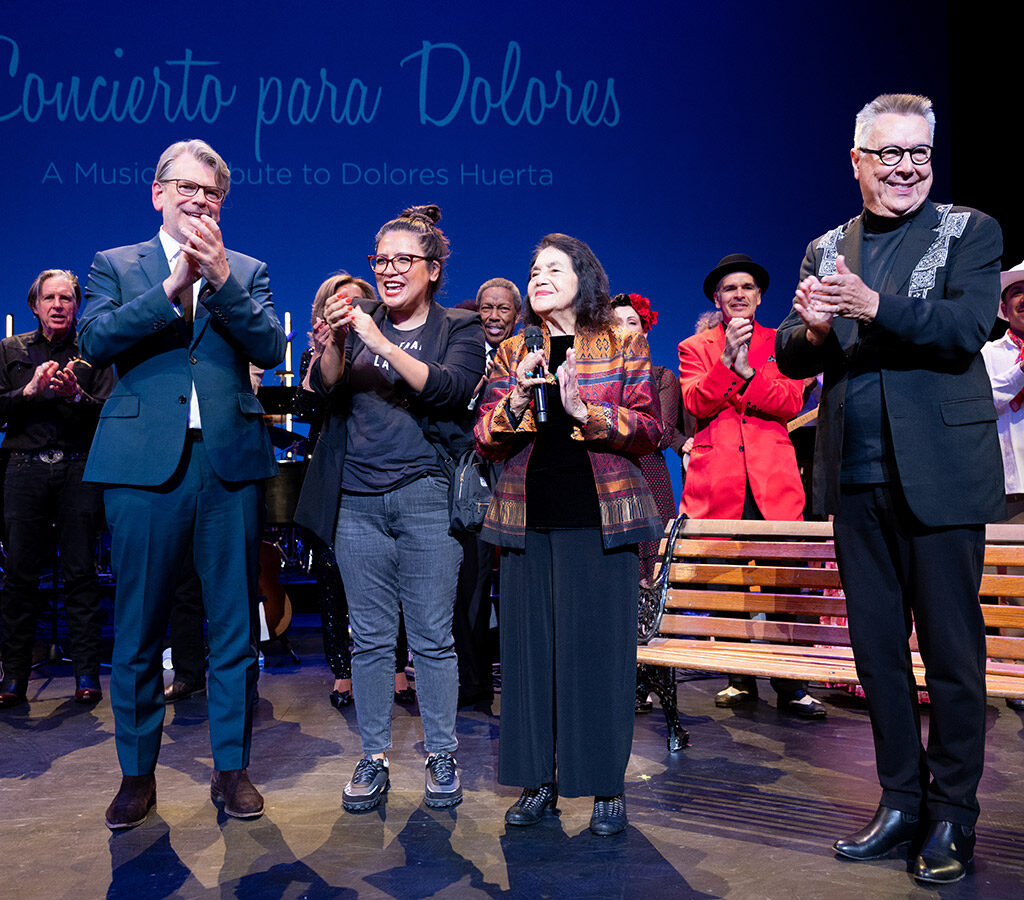
Huerta’s connection to CSUN extended beyond her activism. In 2022, the university celebrated the civil rights icon’s lifelong love of music in a special concert at The Younes and Soraya Nazarian Center for the Performing Arts (The Soraya). The “Concierto Para Dolores: A Musical Tribute to Dolores Huerta” featured performances by La Marisoul, Marilyn McCoo and Billy Davis Jr. and Mariachi Garibaldi de Jaime Cuéllar.
In an interview with CSUN Today before the concert, Huerta recalled her enthusiasm for everything from rancheras and classical music and jazz. She studied Spanish flamenco dance as a teenager and frequently traveled with friends throughout the San Francisco Bay Area and Central Valley to attend concerts.
“We’d say, ‘hey, there’s a really big trumpet player playing in Sacramento,’ so we’d all go to Sacramento. [Or] ‘hey, there’s a really good musician playing in Richmond.’ So we’d go to Richmond. [My friends and I were] totally immersed into music.”
Director Dan Guerrero, a longtime friend of Huerta’s, wanted the concert to reveal a more personal side to the activist through the music and performances she loved.
“They will see what kind of a friend she is and what kind of a mother she was and is,” Guerrero said. “She’s extremely accessible; it’s like meeting with your Tia, you know, she’s like a relative.”
In 2003, Huerta and three of her daughters created The Dolores Huerta Foundation. In the obituary posted on its website, it noted that Huerta, during her long career, was often “the only woman in the room” when it came to negotiations and organizing work. In 2027, the Foundation plans to open the Dolores Huerta Peace and Justice Cultural Center in the Central Valley to continue her groundbreaking work in civil rights.
During her 1995 visit to CSUN, Huerta offered a message to students that reflected the values she championed throughout her life.
“The best education we can have is to have pride in ourselves, to have pride in our culture,” she said. “The best education we can have is to learn how to stand up and how to fight, how to fight for ourselves, and how to fight for our people.”