

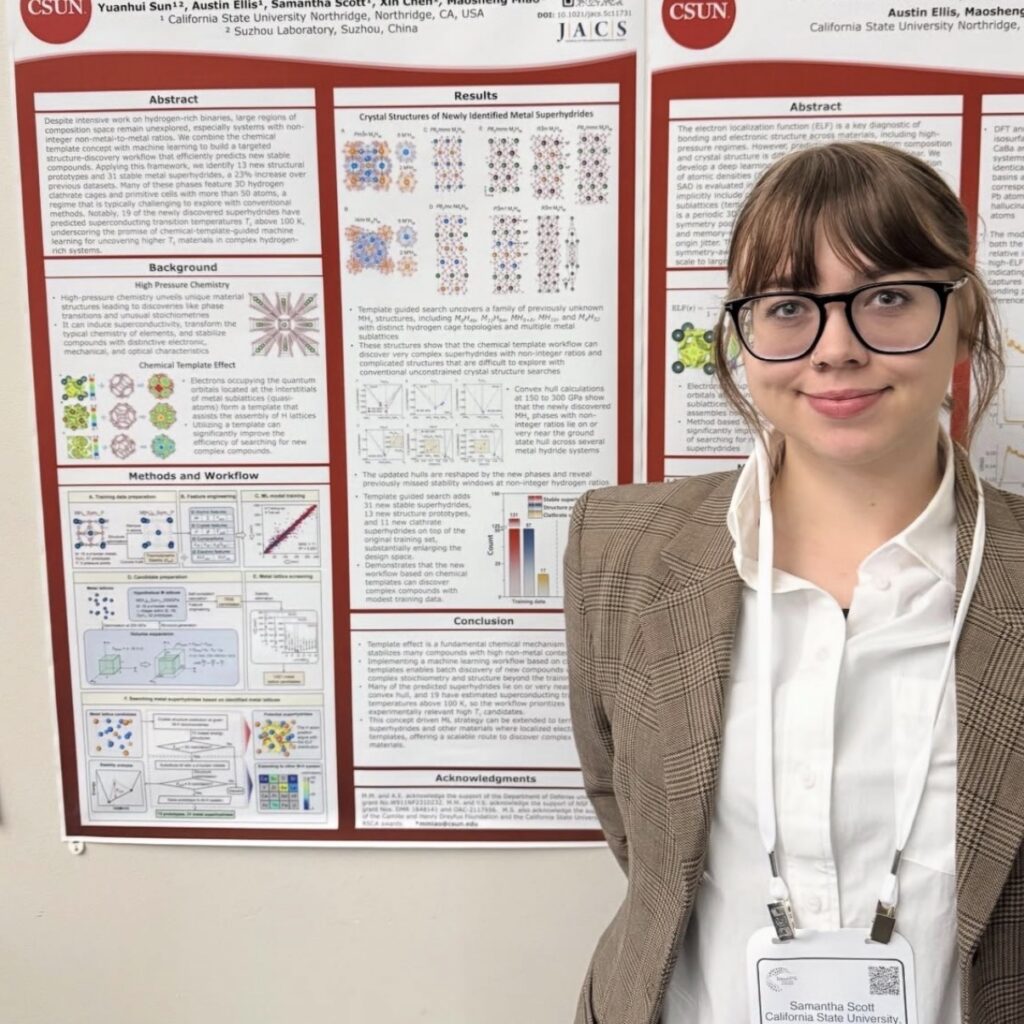
Chemistry master’s student Samantha “Sammie” Ellis and undergraduate astrophysics major Jesus Poblano recently received one of the most competitive and prestigious awards for students in science, technology, engineering and math (STEM), the National Science Foundation Graduate Research Fellowship Program (GRFP).
The program receives nearly 14,000 applications nationwide. Ellis and Poblano were among 2,500 recipients recognized for their research potential and the broader impact of their work. Ellis’ work in computational chemistry and Poblano’s research in astrophysics underscore their academic achievements and highlight how emerging technologies such as artificial intelligence are advancing scientific discovery across disciplines.
Samantha Ellis
Ellis, a first-generation college student, received the fellowship for her work in computer-based chemical research, otherwise known as computational chemistry. She uses artificial intelligence as a tool to better understand and implement advanced chemical theories, accelerating the rate of discovery of new materials. Her research will use AI and machine learning models to help discover “superhydrides,” hydrogen-rich materials that could lead to faster and more energy-efficient technologies.
Ellis’ methodology differs from the typical modeling approach used today, which often requires weeks or even months to generate a short list of possibilities for long-term study. “If we can find a way to train AI to quickly screen all these candidates, then you can narrow down the search space,” she said.
The work she has completed can be applied to many technologies that use superconducting materials, including MRI machines and high-speed train systems. Her research can help improve how these types of materials are discovered and optimized.
Ellis’ academic journey has been far from linear. As a first-generation college student, she initially pursued a pre-med biology degree and, at the time, was uncertain about her long-term goals. After transferring to UC Irvine from Fullerton College, she discovered a passion for chemistry and eventually changed her major. From there, she explored different areas of the field, including atmospheric and organic chemistry, before finding her niche in computational chemistry at CSUN. Ellis credited the support and guidance of CSUN faculty mentors and the Office of Undergraduate Research for allowing her to pursue opportunities such as the NSF Graduate Research Fellowship.
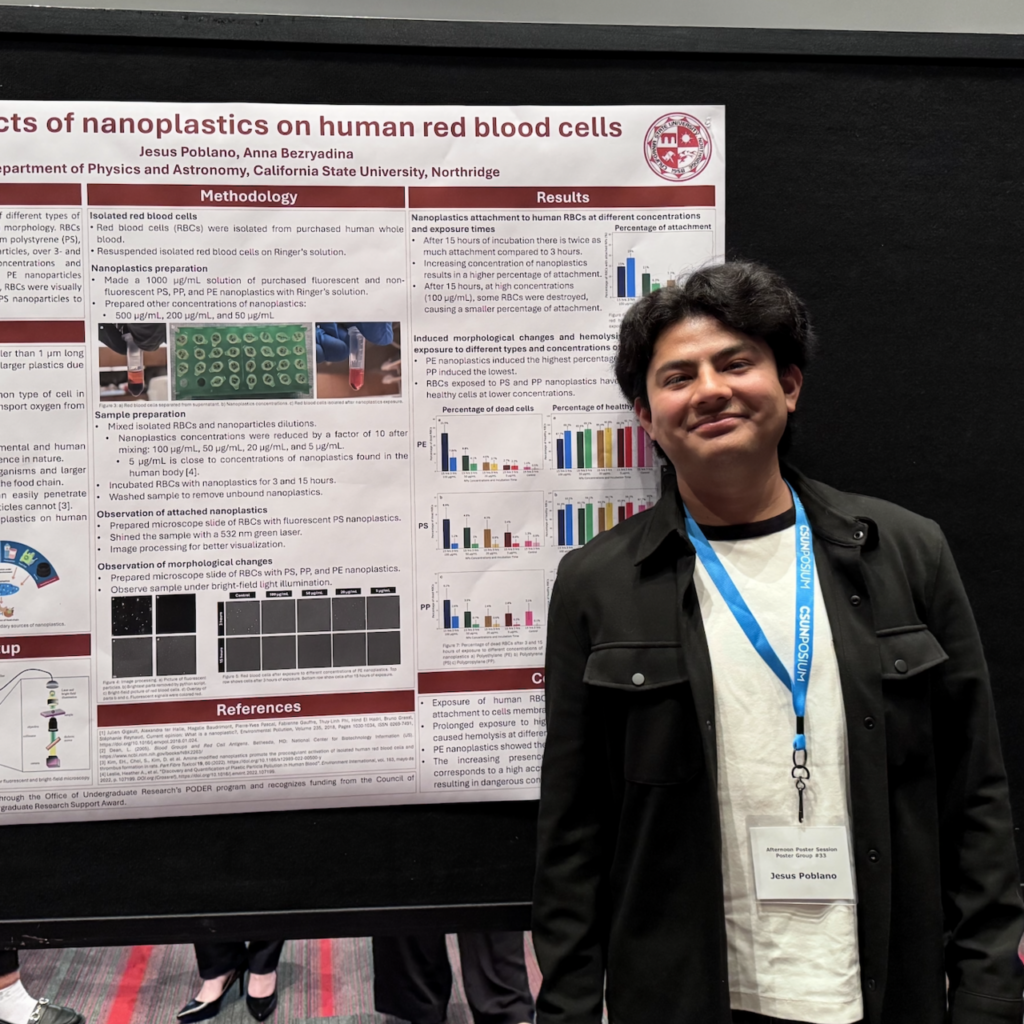
Jesus Poblano
A first-generation college student graduating with a bachelor’s degree in astrophysics, Poblano was selected for the Graduate Research Fellowship for his research combining astrophysics and machine learning to analyze light output from telescopes. The goal: to find patterns that could help identify signs of life using biosignatures.
Using spectroscopy, a technique that studies how gases interact with light, Poblano identifies the types of gases present in a planet’s atmosphere by measuring how much light those gases absorb and emit. Using data collected from telescopes such as the James Webb Space Telescope and the Hubble Space Telescope, Poblano hopes to train machine learning algorithms to detect important atmospheric features, such as possible chemical signs of habitability or biological activity.
By using this method, researchers would be able to handle their data much more swiftly. This is critical because telescope observation hours are limited, he said. “So then, in those 50 hours, you can get more observations of other planets rather than just focusing on one,” Poblano said.
Poblano hopes to enhance efficiency and the reliability of any findings indicating the possibility of life outside our planet. The goal is to find signals “that can only be explained by life, rather than a natural phenomenon,” he said.
He emphasized the importance of building foundational knowledge to help future researchers, adding that he wants to create work where scientists can confidently compare new observations and “make sure that … [they’re] making the right claim.”
Poblano’s research journey has been largely self-driven. In 2024, after joining a biophotonics lab at CSUN, which is a field that combines physics and biology to study how light interacts with living systems, he explored a wide range of topics before narrowing his focus through independent study.
Ellis and Poblano illustrate that persistence, curiosity and openness are essential for long-term success. Ellis encouraged students to step outside their comfort zone. “Don’t be afraid to try new things,” she advised. “You’re never going to know what you like unless you try.” Uncertainty is a necessary part of the research process, she added.
“Stupidity is one of the most important parts of research,” Ellis said. “You’re looking at things you don’t understand and trying to figure it out.”
Looking ahead, both students are continuing to build on their research achievements through new academic opportunities. Ellis will spend the summer conducting research at Oak Ridge National Laboratory, while continuing her master’s thesis work and preparing to apply to Ph.D. programs in computational chemistry and materials science. In the fall, Poblano will begin a Ph.D. program in multidisciplinary astrophysics at Johns Hopkins University, where he plans to further develop his research on exoplanet biosignatures and machine learning applications in astronomy.

Comments are closed.