

Media Contact: Carmen Ramos Chandler, carmen.chandler@csun.edu, (818) 677-2130
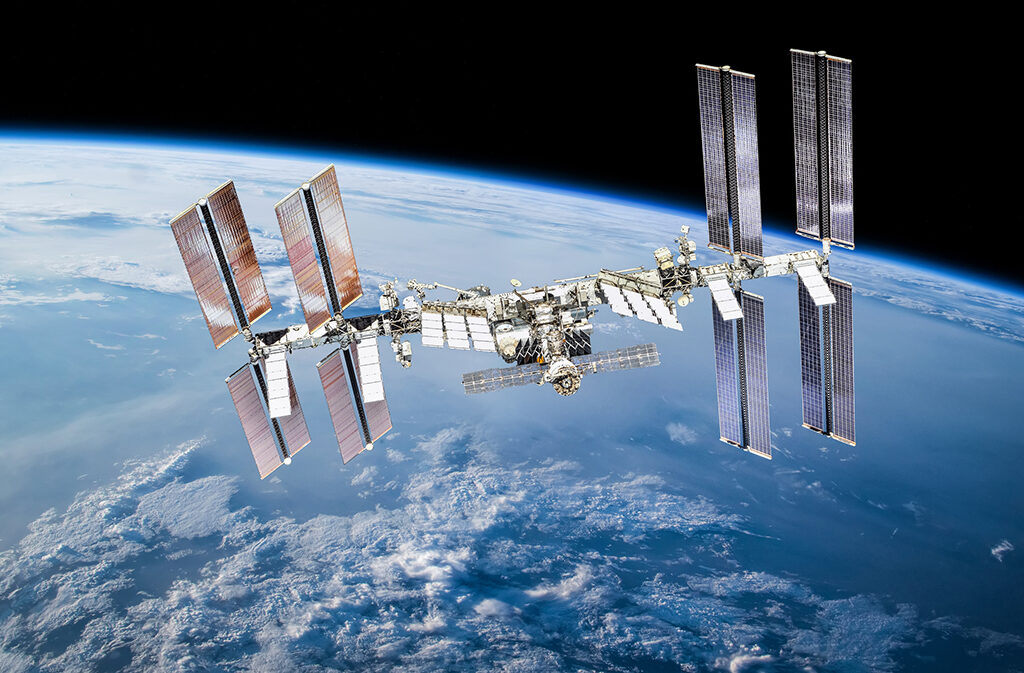
Sometimes, all you want is a salad. However, especially if you’re living on the International Space Station, it’s not always that easy. The conditions, including a lack of gravity and water, can make growing leafy greens near impossible. Chhandak Basu, a biology professor at California State University, Northridge, is hoping to change that.
Basu has received a $400,000 grant from NASA to study how microgravity environments, coupled with drought-like conditions, affect plants, especially salad-like plants, grown in space and explore ways to mitigate the negative effects. This grant was the second consecutive NASA grant, the earlier one was for $300,000, he received to study how a specific salt-tolerant microbe can survive in hostile and stressful environments.

“In the previous grant, we studied the molecular and genomic mechanisms that enable the microbe Halobacterium salinarum to survive exposure to ultraviolet light, heavy metals, and high salt concentrations,” said Basu, who teaches in CSUN’s College of Science and Mathematics. “This research could provide insights into the origin of life and the possibility of life beyond Earth.”
Basu’s latest grant focuses on growing plants in space.
“Astronauts prefer to eat fresh food, most of us do,” he said. “The fruit that they sometimes eat comes in a tube and, to be honest, can taste pretty bad. If they can grow lettuce, spinach, mustard greens, fresh leafy vegetables, all they’ll need to do is bring a bottle of dressing from Earth and they can have a salad that does not come out of a tube-like toothpaste.”
Basu said there was an additional benefit as well, noting that living on the space station can be stressful on the astronauts because they are away from their friends and families and living an enclosed environment.
“When they take care of a plant, watering and nurturing it, it positively impacts their mental health,” he said. “Besides, green is considered a soothing color.”
Basu is partnering with researchers at NASA’s Ames Research Center in Silicon Valley, particularly with Craig Everroad, who is a co-investigator of this grant, to understand what happens when plants, particularly green, leafy plants, grow in microgravity environments like the space station, or in the drought conditions found on the moon or Mars.
Using a clinostat, a device that uses rotation to negate the effects of the gravitational pull on plant grown, Basu, a team of two to three CSUN students and NASA scientists are hoping to “confuse” the plants about where their center of gravity is.
“The plants ‘think’ that they are in space because they don’t know where the center of gravity is, and that will help us understand what happens to these plants in space and give us clues to help them grow in those conditions,” he said.
Basu said his team also plans to characterize microbes that can grow near the root zones of plants cultivated in simulated Martian and lunar soils.
“We are growing them in anticipation of future human space exploration,” he said. “Some of the first questions we asking are can you grow plants in lunar soil or Martian soil? Both of which have extreme drought conditions.”
What the researchers learn about growing plants space could be applicable down here on Earth as the planet continues to experience more drought conditions.
“As water becomes more and more precious, we need all the information we can to help understand how we can grow food in drought conditions,” Basu said.
What makes the project particularly exciting for Basu is that the grant provides funds, including stipends, for take two to three students with him to the Ames Research Center to conduct research alongside NASA scientists.
“It’s really a once-in-a-lifetime opportunity,” Basu said. “It’s an opportunity for them to truly see the potential ahead of them, while helping to conduct research that could help future generations.”


Comments are closed.