As flames and smoke billowed from an enormous frozen food warehouse in Boyle Heights on June 17, mark! Lopez ’15 (M.A., Chicana/o Studies) and his colleagues at the East Yard Communities for Environmental Justice did what they often do in emergencies: They took to the streets in their neighborhood just east of Downtown L.A. — distributing masks and air purifiers to homes just a few blocks from the multistory metal warehouse that burned for more than a week. Lopez is also a lifelong resident of the area that was affected by the smoke and the stench of burning — then, rotting — food.
“One of the members of our organization contacted me and was like, ‘Hey, there’s a fire,’ which is unfortunately not an uncommon message that I receive,” Lopez said. “I stepped outside … and it looked really bad … the density of the smoke, the color. I started contacting our members, my friends, my family.”
About 4,000 residents live right next to the large industrial zone and warehouse district, Lopez said. It includes more recent metal constructions like the one owned by Lineage, which is nearly 500,000 square feet — roughly the size of eight football fields. These massive buildings loom over the older businesses nearby — some decorated with hand-painted murals on their cinderblock and brick walls.
“What I was exposed to [during the fire], what my family was exposed to, depended on where the wind was blowing, but for those residents who live right up against the facility, it was 24/7. There was no relief for them,” Lopez said.
Protecting Communities
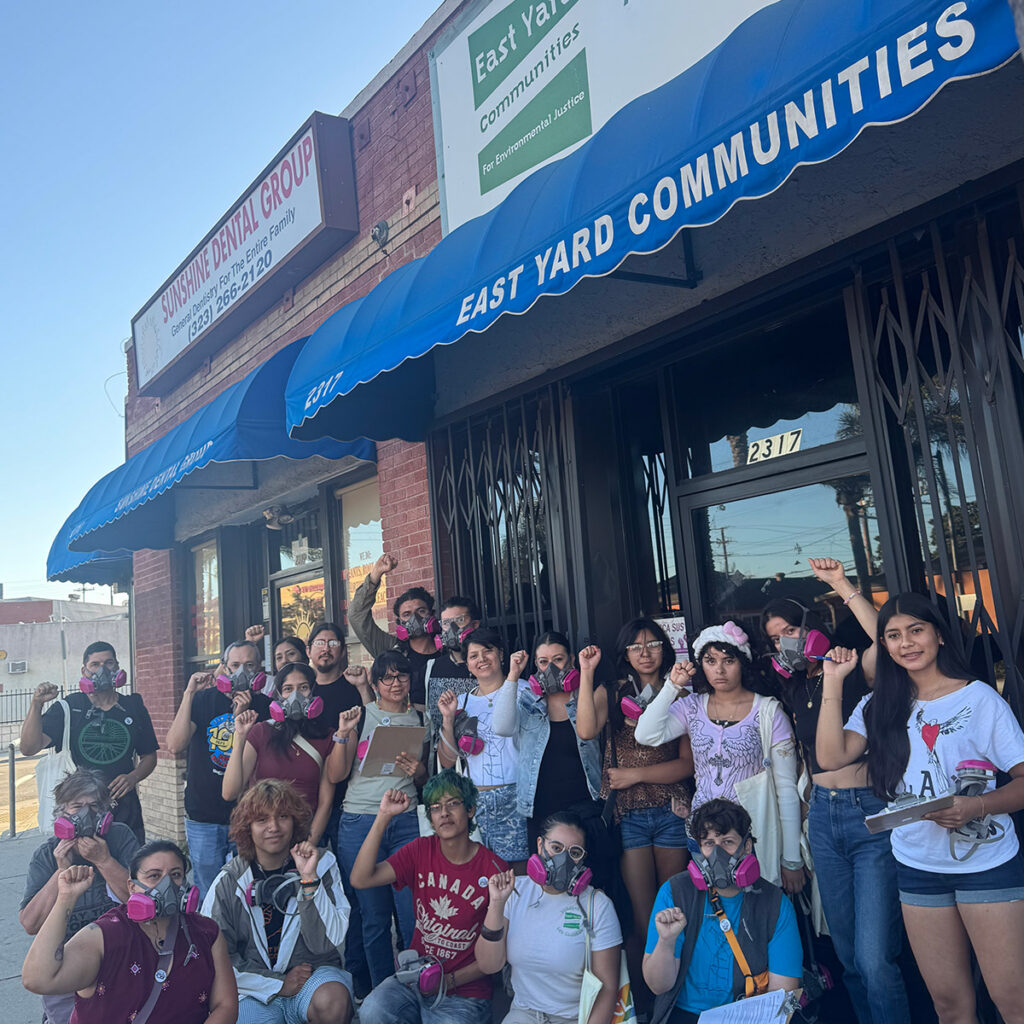
Residents suffered through the reeking aftermath for weeks, and Lopez and his colleagues shifted their efforts toward collecting data. They tested runoff flowing into the Los Angeles River and conducted air quality monitoring at multiple points throughout the community. Lopez said the community organization’s efforts greatly expand on monitoring done by state and local agencies.
“That’s a lot of what our work is, unfortunately,” he said. “It’s when the agencies that are responsible for this are failing, then we have to get out there and do it ourselves to protect our communities.”
Lopez and members of East Yard Communities also pushed the Los Angeles County Department of Public Health for a CASPER study — a Community Assessment for Public Health Emergency Response, created by the Centers for Disease Control and Prevention. It’s a survey to determine the health impacts from a disaster and what residents need. Lopez and volunteers went door-to-door, asking questions about physical health effects such as respiratory issues. They also heard about the emotional toll.
“74% of respondents said that it worsened their mental health,” Lopez said. “We had designed the survey to take maybe 15 minutes. Instead, we were sitting in people’s homes for an hour and a half, talking about what they’re experiencing … their fears,” he said.
Fighting for Environmental Justice
For Lopez, this is just the latest work he — and his family — has done to bring attention and remediation to this community that has experienced severe industrial pollution. Lopez credits his grandparents for fostering his fervent community activism — Juana Beatriz Gutierrez and Ricardo Gutierrez co-founded the Madres de Este de Los Angeles Santa Isabel (Mothers of East L.A. Santa Isabel, or MELASI) organization, formed in the mid-1980s to fight the construction of a state prison in their neighborhood. Their work, through the generations, is the subject of a recent documentary.
While Lopez earned a bachelor’s degree in environmental studies at UC Santa Cruz, then a master’s degree in Chicana/o studies at CSUN, his efforts to repair the damage in his hometown continued — and shaped his studies. In 2017, he received the prestigious Goldman Environmental Prize (North America) for his work to expand the clean up of decades-old contamination from the Exide battery facility that was located in Vernon, southeast of Downtown L.A.
His master’s degree studies provided even more context to his ongoing fight for environmental justice, Lopez said.
“Going to Cal State Northridge for Chicana/o Studies really allowed me to enrich [my previous studies] with a critical race analysis,” he said. “Environmental harm doesn’t exist in a vacuum … Chicana/o Studies being rooted in community movement, in student movement, is trying to address the needs of and futures of our communities. It’s almost like a lens for seeing the world.”
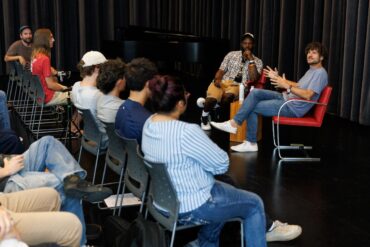
Lopez reflected on his time in classes with CSUN professors in the College of Humanities, like Mary Pardo, who wrote “Mexican American Women Activists” about the Mothers of East L.A. groups, and Rosa RiVera Furumoto, who taught a class on field work in the barrio.
“Our scholarly work and all of our work has to have purpose,” he said. “Research needs to serve a purpose … to inform our communities and activate them — to take action.”
Lopez also teaches, as an adjunct professor in the Keck School of Medicine at USC. He also has taught at CSUN, UC Santa Cruz and UCLA Extension.
Moving Forward
East Yard has filed a notice of intent to sue in the wake of the Lineage warehouse fire, in part to push for publicizing more information about the fire and its aftermath, Lopez said. For the long term, he and organization members are raising money to purchase a warehouse in their community — what Lopez called an “intentional effort to encroach back, to reclaim some of that space.”
“It’s a resiliency hub, a place for community-based innovation,” he said.
The term “resilience” is key to thinking about the future of his neighborhood — and others, Lopez noted.
“Large, centralized efforts aren’t necessarily going to get it done for our communities,” he said. “[It’s] community-based, decentralized efforts … that’s part of the vision for this warehouse — to create a whole new space for our organization and our community to grow in how we prepare ourselves for the multitude of issues we face.”