

Media Contact: Javier Rojas, javier.rojas@csun.edu, or Carmen Ramos Chandler, carmen.chandler@csun.edu, (818) 677-2130
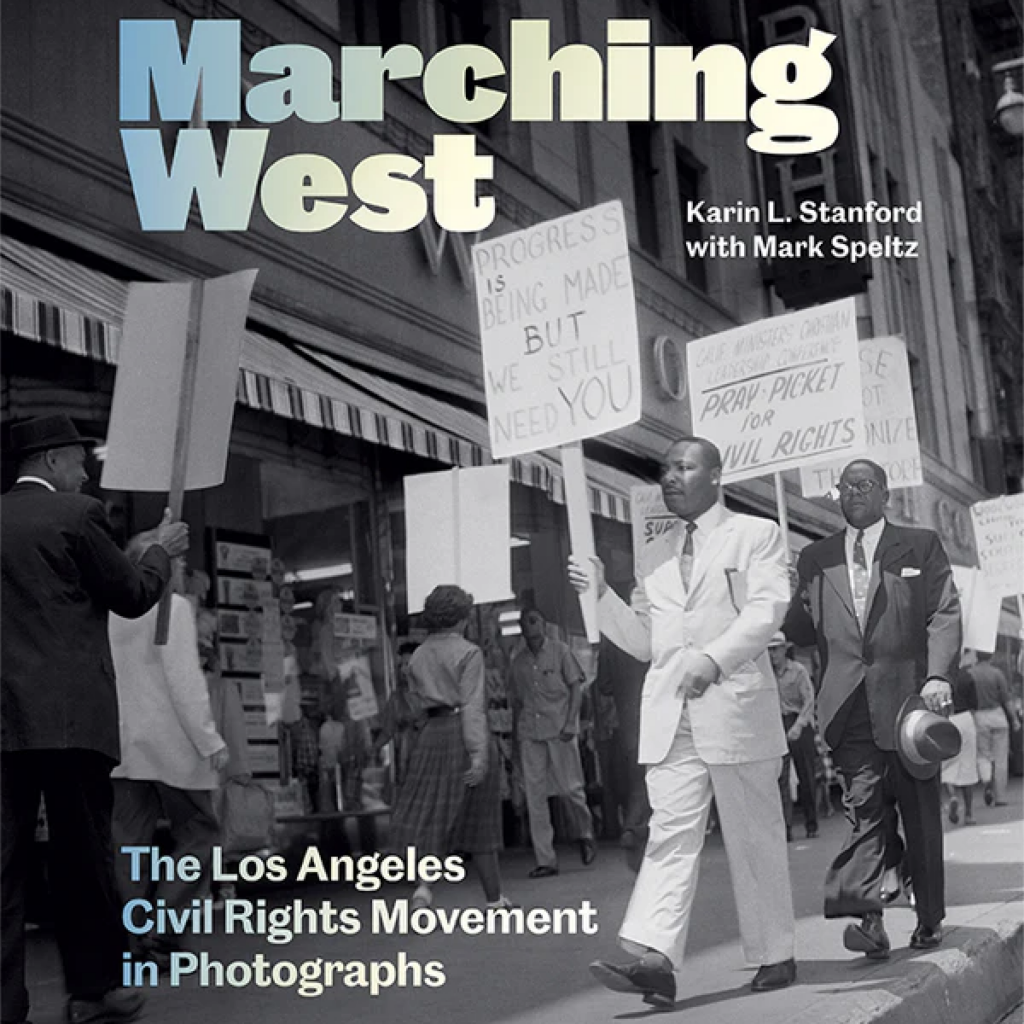
Karin L. Stanford, a California State University, Northridge professor of political science in the Department of Africana Studies, discovered that little of the civil rights activism that took place in Los Angeles has been told in schools or books.
To bring those stories to light, she has gathered images of that activism for her book, “Marching West: The Los Angeles Civil Rights Movement in Photographs.”
“I want to bring in local history because that’s how students connect to the work and history. I could not find a book about it, but I grew up here. I know there was a movement because my family was involved in it,” said Stanford, whose work focuses on social movements and African-American politics. “After a decade of waiting and hoping that someone would publish a book on the subject I decided, ‘Okay, I must do it.’”
More 100 images, some of which have never been published previously, have been drawn from the Tom and Ethel Bradley Center at CSUN, the Getty Research Institute and other collections.
Many of the photographs reveal connections between local and national movements, highlighting the action that took place in Los Angeles. History such as Martin Luther King Jr. creating an organization called the Western Leadership Conference that was established in Los Angeles and which Stanford included in the book.
“We had our own local struggles with discrimination, and Dr. King became very engaged and fought alongside our community,” said Stanford, who teaches in CSUN’s College of Social and Behavioral Sciences. “Los Angeles is very diverse, and so is the movement. People from the San Fernando Valley, San Diego, and Pasadena were involved. In terms of photography, at the time there were no ‘real’ images reporting the brutality that people faced, and these photographers were taking pictures the whole time. It became like a tool of the movement.”
It is likely that middle school and high school students do not know much about civil rights history in Los Angeles,Stanford said, adding that she hopes “Marching West” will help schools teach a more complete history — “one that reflects the civil rights legacy of Los Angeles and the communities that shaped it.”
The book is scheduled to be published by Getty Publications on June 16. For more information, visit the Getty’s website.



Comments are closed.